How OOH Advertising Creates Strong Brand Recall in High Traffic Areas

We live in an age of “digital exhaustion.” We’ve all been there scrolling through a feed, mindlessly flicking past ads for shoes we already bought or software we don’t need. Our brains have developed a subconscious “delete” button for anything that pops up on a six-inch glass screen.
But then, you look up.
You’re stuck at a red light that feels like it’s been red for an eternity. Or you’re standing on a metro platform, waiting for the 8:15 AM train. Suddenly, that massive, vibrant hoarding at the junction or the wrapped pillars in the station don’t feel like “marketing.” They feel like a part of the scenery.
This is the raw power of Out-of-Home (OOH) advertising. It doesn’t fight for a slice of your data; it claims a slice of your reality.
1. The “Forced Gaze” at the Signal
In high-traffic urban areas, time stretches. A two-kilometer drive in a city like Mumbai or Bangalore can take thirty minutes. During those thirty minutes, your phone is a distraction, but the world outside the windshield is your primary reality.
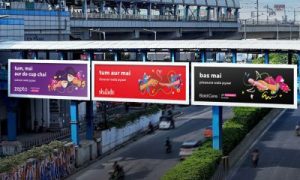
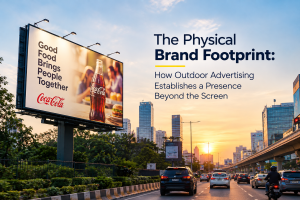
When a brand takes over a massive unipole at a major intersection, it’s not just an ad it’s a landmark. You see it on Monday, you notice the colors on Tuesday, and by Friday, you’re reciting the tagline in your head. You can’t “swipe left” on a physical structure. It builds a mental map. When you finally go to a supermarket, that brand feels like an old friend because you’ve “spent time” with it every morning.

2. High-Traffic Means High-Trust
There is a subtle psychological trick that happens when we see a brand “out in the wild.” If I see a weird ad on a random website, I’m suspicious. But if I see a brand splashed across a 60-foot hoarding at a premium city square, my brain assumes they are legitimate.
We know, instinctively, that OOH is a commitment. It’s expensive, it’s physical, and it’s public. That “bigness” creates an immediate sense of authority. A brand that can dominate a high-traffic zone isn’t just selling a product; they are announcing their arrival. For the consumer, that scale translates directly into trust.
3. Catching the “Bored” Brain
Most digital ads are an interruption. They stop you from watching a video or reading a tweet. That creates a tiny spark of annoyance every time.
OOH is the opposite. It’s an invitation. When you’re standing on a railway platform or waiting for a bus, you are bored. Your brain is literally looking for something to process. A clever OOH campaign maybe a 3D anamorphic display where a car seems to drive out of the screen, or a witty copy on a bus shelter doesn’t annoy the viewer. It rewards them. It gives them something to look at.
4. The Contextual Trigger
OOH knows exactly where you are. A digital ad thinks it knows you because of your search history, but a billboard knows you’re currently stuck in 40°C heat.
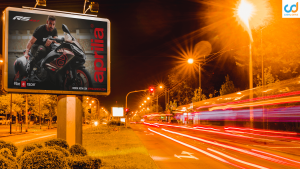
When a beverage brand puts up a “frosty, condensation-covered” bottle on a backlit hoarding during a summer traffic jam, it’s not just advertising. It’s a sensory trigger. It hits a physical need in that exact moment. That kind of contextual timing creates a recall that stays in the gut, not just the head.

5. It’s the “Final Push”
We often see OOH as the start of a campaign, but it’s actually the “closer.” You might have heard of a new sneaker brand online, but when you see a massive, high-definition creative of those sneakers at the entrance of a luxury mall, that’s when the decision happens. It moves the needle from “I’ve heard of that” to “I need that.”
Why OOH Still Wins in 2026
In a world of deepfakes and AI-generated noise, physical space is the only thing that feels real. OOH advertising in high-traffic zones provides a “physical footprint” for a brand. It says, “We are here, we are real, and we are part of your city.”
As long as humans have to move from point A to point B, the road will always be the most effective place to tell a story. You can turn off your phone, but you can’t turn off the city.