Smart OOH Media Planning Strategies for Multi City Campaigns
Planning a multi-city OOH (Out-of-Home) campaign in a country as diverse as India isn’t just about buying the biggest billboards in Delhi, Mumbai, and Bangalore. If you treat every city the same, you’re essentially throwing your marketing budget into a black hole. Each city has its own pulse, its own specific “clog points” in traffic, and its own cultural nuances that dictate whether a brand feels like a “premium outsider” or a “local favorite.”
To win across multiple regions, you need a strategy that balances massive scale with surgical local precision. Here is how to build a smart OOH media plan that actually moves the needle in a multi-city rollout.
1. The “Transit Core” Strategy: Mapping the City’s Pulse
Every city moves differently. In Mumbai, the lifeblood is the local train network and the Western Express Highway. In Bangalore, it’s the tech corridors like ORR and Sarjapur. In Delhi, it’s the massive metro interchanges and the DND flyway.
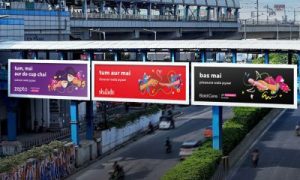
A smart media plan doesn’t just look for “high traffic” it looks for “dwell time.” * The Strategy: Don’t just buy 100 random boards. Identify the “bottlenecks” where people are forced to sit in traffic for 10–15 minutes.
-
The Human Element: A commuter in a 20-minute jam at a Silk Board junction (Bangalore) has a much higher recall of a billboard than someone zooming past a highway unipole at 80 km/h. Map your media to the speed of the city.

2. Tiered City Archetypes: One Size Does Not Fit All
You cannot use the same media mix for a Tier-1 metro and a Tier-2 emerging hub like Jaipur or Lucknow.
-
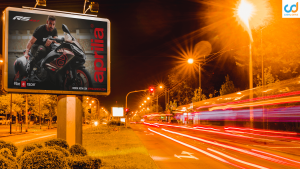
Tier-1 (Metros): Focus on Dominance and Tech. Use anamorphic 3D LED screens in premium hubs (like Cyber Hub or BKC) to create “social media moments.” Digital OOH (DOOH) works best here because the audience is tech-savvy and distracted.
-
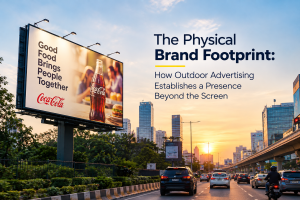
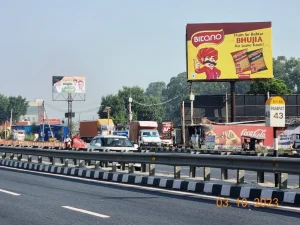
Tier-2 & Tier-3: Focus on Trust and Visibility. Traditional static hoardings, bus shelters, and branding at major “Chowks” (intersections) still reign supreme. In these cities, a massive physical presence at a central landmark creates a sense of “The brand has arrived,” which is a powerful trust-builder.
3. The “Last Mile” Integration (RWA & Hyperlocal)
A multi-city campaign often fails because it stays “on the road” and never enters the “home.” To truly convert, you need to follow the consumer from the highway to their doorstep.
-
The Strategy: Pair your large-format city billboards with RWA (Resident Welfare Association) advertising.
-
The Logic: If a consumer sees your brand on a massive hoarding on their way home, and then sees a digital screen in their apartment elevator five minutes later, the “Recall Loop” is closed. This multi-touchpoint approach inside gated communities across 5–6 cities ensures the brand isn’t just a “sky-high logo” but a household name.
4. Dynamic Content: Contextualizing for the Local
One of the smartest moves in multi-city planning is Dynamic DOOH. Thanks to programmatic OOH, you can now change your creative based on real-time data without manual labor.
-
Weather-Triggered Ads: If it’s raining in Mumbai but a heatwave in Delhi, your DOOH screens should reflect that. A beverage brand can show “Cool down” in Delhi and “Stay dry with a hot brew” in Mumbai simultaneously.
-
Language Nuance: Don’t just translate; transcreate. A tagline that works in Hindi in Noida might feel flat in Chennai. Using local slang or cultural references on your OOH units makes the brand feel “human” and accessible, rather than a cold corporate entity.

5. Data-Driven Selection (Beyond the “Gut Feeling”)
Gone are the days when media planning was done by looking at a map and pointing. Smart planning in 2026 uses mobility data.
-
The Strategy: Use heatmaps to see where your target demographic (e.g., “High-income tech workers” or “Stay-at-home parents”) actually spends their time.
-
The Logic: You might find that your audience in Hyderabad spends more time at premium malls, while in Pune, they are concentrated around specific “Eat-Street” clusters. Move your budget to where the eyeballs are, not where the most expensive hoardings are.
6. The “Frequency” over “Reach” Trap
Many brands try to cover “the whole city” and end up with one board in twenty different areas. This is a mistake.
-
The Pro Tip: It is better to dominate one high-traffic corridor with five boards (creating a “brand tunnel” effect) than to have ten boards scattered across the city. Frequency builds memory; scattered reach builds “glimpses” that are easily forgotten.
Conclusion
Smart multi-city OOH planning is about empathy. It’s about understanding that a person in Kolkata is in a different headspace than someone in Gurgaon. By combining high-impact Digital OOH in metro centers, RWA branding for trust, and dynamic creative for relevance, you create a campaign that doesn’t just sit on a wall it stays in the mind.