RWA Advertising vs Mall Advertising: Which One Works Better for Urban Brands?
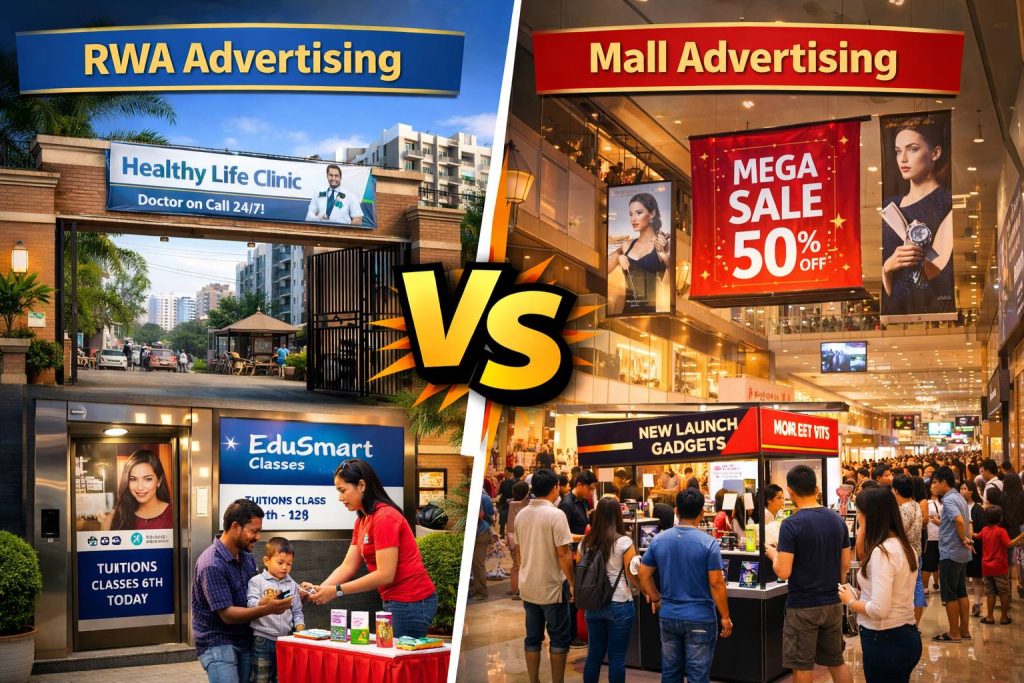
The modern urban brand in India is currently caught between two vastly different physical worlds: the spectacular, high-traffic corridors of the shopping mall and the intimate, trust-based environment of the Residential Welfare Association (RWA). As we navigate the marketing landscape of 2026, the question is no longer about which medium has “more eyeballs,” but which medium captures the right kind of attention. Deciding between a mall and a residential society requires a brand to choose between “Fame” and “Function.“
The Psychology of Intent vs. Routine
The mall is a cathedral of consumption. When a consumer enters a premium shopping center, they are mentally prepared to part with their money. They are in a high-energy, aspirational state, making malls the undisputed kings of “Brand Glamour.” If a brand is launching a new fashion line, a flagship smartphone, or a cinematic experience, the mall atrium provides a stage that feels like an event. However, this high energy comes with a price extreme competition. In a mall, a brand is a whisper in a thunderstorm, fighting for a few seconds of attention against hundreds of other glittering storefronts.
Conversely, RWA advertising operates in the “Zone of Routine.” Within a gated society, the resident is relaxed, unhurried, and psychologically “at home.” An advertisement here doesn’t feel like a commercial interruption; it feels like a neighborhood update. This is where “Function” wins. For brands selling long-term lifestyle shifts like home automation, premium healthcare, or high-end education—the quiet repetition of an RWA campaign builds a layer of trust that the frantic environment of a mall can never replicate. In a mall, you catch a consumer’s eye; in an RWA, you enter their daily conversation.
The Battle for High-Value Dwell Time
One of the most misunderstood metrics in OOH (Out-of-Home) advertising is “Dwell Time.” In a mall, dwell time is high in aggregate, but it is “moving time.” A shopper might spend four hours in the building, but they are constantly in transit from the parking lot to the cinema or the food court. Unless a brand’s activation is physically blocking their path, the interaction is fleeting.
In an RWA, dwell time is “captured time.” Whether it is the thirty seconds spent waiting for an elevator or the five minutes spent walking through the lobby to the car, these are moments of low mental friction. Residents are not yet distracted by the chaos of the city or the lure of a sale. By placing branding in these high-traffic bottlenecks, a brand achieves a frequency of exposure that is impossible in a mall. A resident doesn’t just see the ad once; they see it twice in the morning and twice in the evening, every single day. This “forced frequency” is what turns a new brand into a familiar household name over a 30-day period.

Precision vs. Prestige
The mall is a “mass-premium” medium. It attracts the wealthy, but it also attracts thousands of window shoppers and casual strollers. For a brand, this leads to significant “ad spillage” you are paying for the total footfall, not just your target demographic. This is perfectly acceptable for FMCG or entertainment brands looking for volume, but it is inefficient for niche luxury services.
RWA advertising is a surgical strike. In 2026, brands are selecting societies based on data-driven profiles: the average rental yield of the building, the density of luxury SUVs in the basement, or the number of school-going children in the complex. This allows a brand to ignore the “mass” and focus entirely on the “micro.” There is no wastage. Every person who sees the ad is a qualified prospect. For a premium EV brand or a high-end interior design firm, the ability to target only the top 5% of a city’s residential towers is far more valuable than a flashy presence in a crowded mall.
The Cost of Closure
Ultimately, the decision often comes down to the bottom line. Mall advertising is high-stakes and high-cost. It is an investment in “Brand Equity.” It tells the world that the brand has arrived. But the path to a lead or a sale is often long and indirect.
RWA advertising is the master of “Conversion.” Because the brand is physically present at the site of the home, the “call to action” is much easier to fulfill. Whether it’s a home-test-drive, a free water purity check, or a doorstep delivery of a trial product, the friction of distance is removed. In the world of urban branding, the mall builds the dream, but the RWA closes the deal.
Conclusion
The choice between the two is a choice of strategy. If the goal is to create a cultural moment, to be seen as a leader, and to attract the “New-India” shopper in their most aspirational state, the mall remains the gold standard. But if the goal is to build deep-rooted trust, achieve high-frequency recall, and drive hyper-local sales without the noise of competition, the residential society advertising is the superior battleground. The most successful urban brands are those that realize they need the mall to be famous, but they need the RWA to be essential.