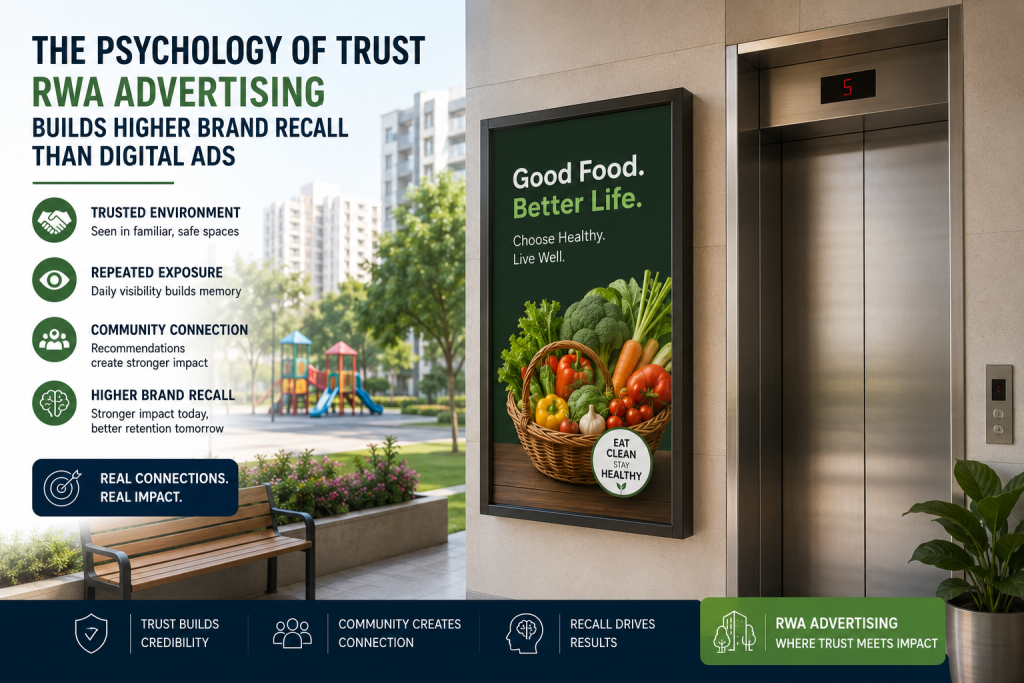
The Psychology of Trust: Why RWA Advertising Generates Higher Brand Recall Than Digital Ads.
In today’s digital-first world, consumers are constantly surrounded by online advertisements across social media platforms, websites, mobile applications, and streaming services. While digital marketing offers extensive reach and targeting capabilities, it also faces a growing challenge—advertising fatigue. Consumers often ignore, skip, or block digital advertisements, reducing their overall effectiveness.
This is where Residential Welfare Association (RWA) advertising stands apart. By placing brands directly within trusted residential environments, RWA advertising creates meaningful interactions that result in stronger brand recall and higher consumer trust. Understanding the psychology behind this trust reveals why residential advertising continues to outperform many digital channels.
Understanding Consumer Trust in Advertising
Trust plays a crucial role in influencing purchasing decisions. Consumers are more likely to engage with brands they perceive as reliable, familiar, and relevant to their daily lives.
Residential communities naturally foster a sense of security and credibility. When residents repeatedly encounter a brand within their own society premises, they often view it as more trustworthy than advertisements appearing randomly online.
This psychological association between familiar environments and brand messaging significantly impacts consumer perception and memory.

Why Digital Ads Often Struggle with Recall
Information Overload
Modern consumers see hundreds of advertisements every day. This overwhelming volume of content makes it difficult for any single message to stand out.
Banner Blindness
Many internet users unconsciously ignore online advertisements because they have become accustomed to seeing promotional content on digital platforms.
Ad Skipping Behavior
Video advertisements, pop-ups, and sponsored posts are frequently skipped or dismissed within seconds, limiting brand exposure.
Short Attention Spans
Digital content competes for attention against countless distractions, making sustained engagement increasingly difficult.
As a result, many digital campaigns achieve impressions but fail to create lasting memory.
The Psychology Behind RWA Advertising Success
Familiar Environment Creates Trust
Consumers generally trust messages delivered within familiar surroundings. Residential societies are associated with safety, comfort, and daily routine.
When a brand appears on society gates, elevators, clubhouses, notice boards, or community events, residents perceive it as more relevant and credible.
Repeated Exposure Strengthens Memory
Psychologists refer to the “mere exposure effect,” where repeated encounters increase familiarity and positive perception.
RWA advertising naturally benefits from this principle because residents encounter the same message multiple times throughout the day.
Community-Based Validation
When multiple residents engage with a campaign or discuss a product, it creates social proof. Community acceptance often influences individual purchasing decisions.