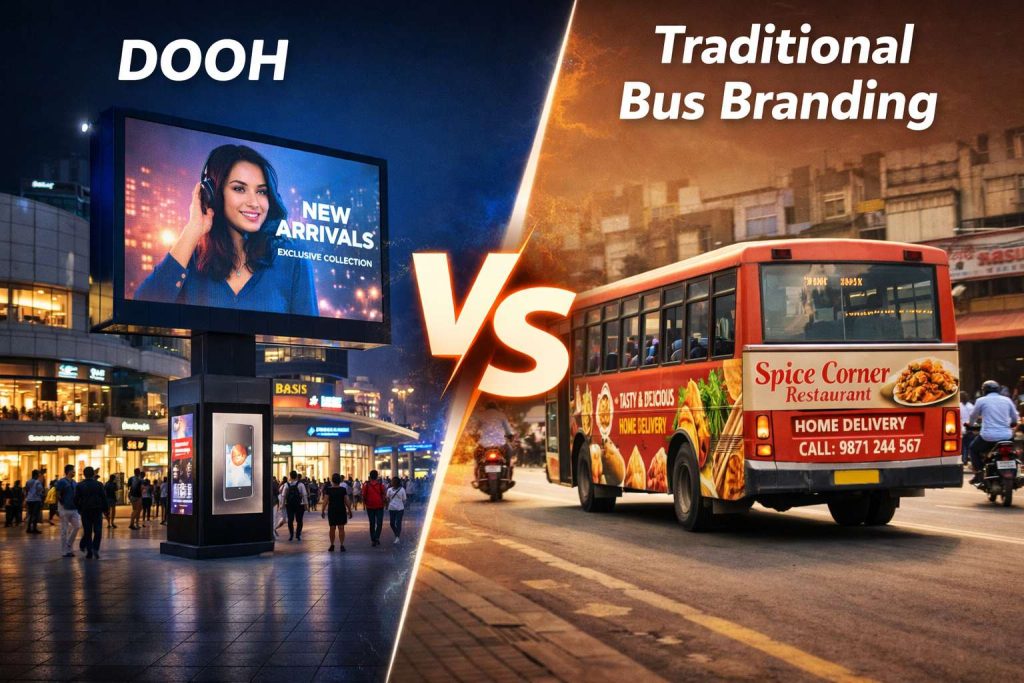

As we move through 2026, the Indian streetscape is changing faster than ever. For a brand manager, the choice of where to put a marketing budget is no longer simple. You are no longer just choosing a bus; you are choosing a technology. The debate between Digital Out-of-Home (DOOH) and Traditional Static Bus Branding has become the central question for transit media.
On one side, you have the high-tech, glowing screens of DOOH that promise agility and modern appeal. On the other, you have the “King of the Road” the full traditional bus wrap which offers a level of physical dominance that a screen simply cannot match. To make the right choice, brands must understand that these are not just different “looks,” but entirely different strategies.
The Case for DOOH: Agility and Real-Time Context
DOOH is the rising star of 2026. These are digital screens mounted on the exterior or interior of buses that allow brands to change their message in an instant. The primary advantage here is flexibility. In a world where news and trends change every hour, DOOH allows a brand to stay perfectly relevant.
Imagine a beverage brand that shows a “hot tea” ad in the rainy morning and switches to a “chilled soda” ad as the temperature rises in the afternoon. This is “Contextual Marketing.” Because the screens are connected to the cloud, you can trigger ads based on the weather, the time of day, or even the specific neighborhood the bus is entering.
DOOH also allows for “Slot-Based” advertising. If you are a small business with a limited budget, you don’t have to buy the whole bus. You can buy a specific time slot, making premium transit media accessible to everyone. It feels modern, high-tech, and perfectly aligned with the “Digital India” vision.
The Case for Traditional Branding: Unrivaled Physical Dominance
While DOOH is agile, Traditional Bus Branding is “Dominant.” A full bus wrap is a 40-foot moving billboard that owns the road. In 2026, where digital fatigue is at an all-time high, the physical, tactile nature of a high-quality vinyl wrap has a unique power. It is “Unskippable” in the truest sense of the word.
A traditional wrap gives you 100% “Share of Voice.” On a DOOH screen, your ad might rotate with five other brands every ten seconds. With a traditional wrap, you own that vehicle 24/7. There is no rotation, no flickering screens, and no technical glitches.
The “Bigness” of a full wrap builds massive brand trust. When a consumer sees a bus completely covered in a brand’s colors, the psychological impact is one of “Authority.” It tells the market that you are a leader. For local giants in real estate, education, or healthcare, this permanent physical presence is often more valuable than a fleeting digital slot.

Comparing Cost-Effectiveness and Longevity
When we look at ROI, the two formats serve different goals. DOOH usually has a lower entry cost because you are sharing the screen space. It is perfect for short-term “Tactical” campaigns like announcing a 2-day flash sale or a movie release. You pay for the time you need, and the campaign ends.
Traditional Branding is a “Long-Term Asset.” While the initial cost of printing and mounting a high-quality wrap is higher, the “Cost Per Impression” over six months is incredibly low. A traditional wrap works for you every single hour the bus is on the road. It doesn’t require electricity, it doesn’t break down, and it looks just as good in bright sunlight as it does in the evening.
For brands looking to build deep, long-term “Top-of-Mind Awareness” in a specific city, the traditional wrap remains the gold standard. It becomes a part of the city’s visual fabric. People start to recognize “the blue bus” or “the orange bus” as a local landmark.
The “Glare and Weather” Factor in India
In the Indian context, environment matters. DOOH screens, while beautiful, face challenges with extreme heat, monsoon rain, and the blinding glare of the afternoon sun. While technology has improved in 2026, a digital screen can sometimes lose its impact under the harsh midday sun.
Traditional vinyl wraps, specifically those using high-grade UV-protected materials, thrive in these conditions. They are designed to withstand the dust of Rewa or the humidity of Mumbai without losing their color. A well-maintained traditional wrap looks “premium” from every angle, regardless of the lighting conditions.
Conclusion: Which One Should You Choose?
The choice between DOOH and Traditional Bus Branding depends entirely on your campaign’s “Soul.” If your goal is to be fast, reactive, and tech-savvy, DOOH is your best friend. It is the choice for brands that want to play with data, time-slots, and changing messages.
However, if your goal is to build a “Power Brand” if you want to own a territory and be seen as the undisputed leader of a neighborhood Traditional Bus Branding is still the winner. It offers a level of “Physicality” and “Permanence” that a digital screen can never replicate.
In 2026, the most successful brands will likely use a “Hybrid Strategy.” They will use Traditional Wraps for long-term trust and DOOH for short-term excitement. By understanding the strengths of both, you can ensure that your brand doesn’t just move through the city, but actually stays in the minds of everyone who sees it.