
In the world of advertising, there’s a famous psychological concept known as the “Mere Exposure Effect.” It suggests that people tend to develop a preference for things merely because they are familiar with them. In the chaotic, high-speed environment of modern cities, few mediums harness this psychological trigger as effectively as bus advertising.
While a digital ad can be swiped away and a television commercial can be skipped, a bus is a literal 12-ton moving canvas that weaves through the daily lives of your target audience. But the secret to its success isn’t just its size it’s frequency.
Here is how the constant, repetitive presence of bus ads builds an unbreakable bond of brand recall with the modern consumer.
1. The Power of the “Commuter Routine”
Most urban residents follow a strict “path of travel.” They take the same route to work, drop their kids at the same school, and visit the same gym at the same time every day. This predictability is a goldmine for advertisers.
When a brand advertises on a specific bus route, it isn’t just seen once; it becomes a part of the shopper’s landscape. By the fifth time a commuter sees your brand wrapped around the “Route 202” bus, they stop seeing it as an “advertisement” and start seeing it as a familiar landmark. This transition from “stranger” to “acquaintance” is the foundation of brand trust.

2. Overcoming “Ad-Blindness” Through Movement
Static billboards have a shelf life. After a week of sitting in the same spot, our brains begin to categorize them as “background noise,” and we stop seeing them entirely.
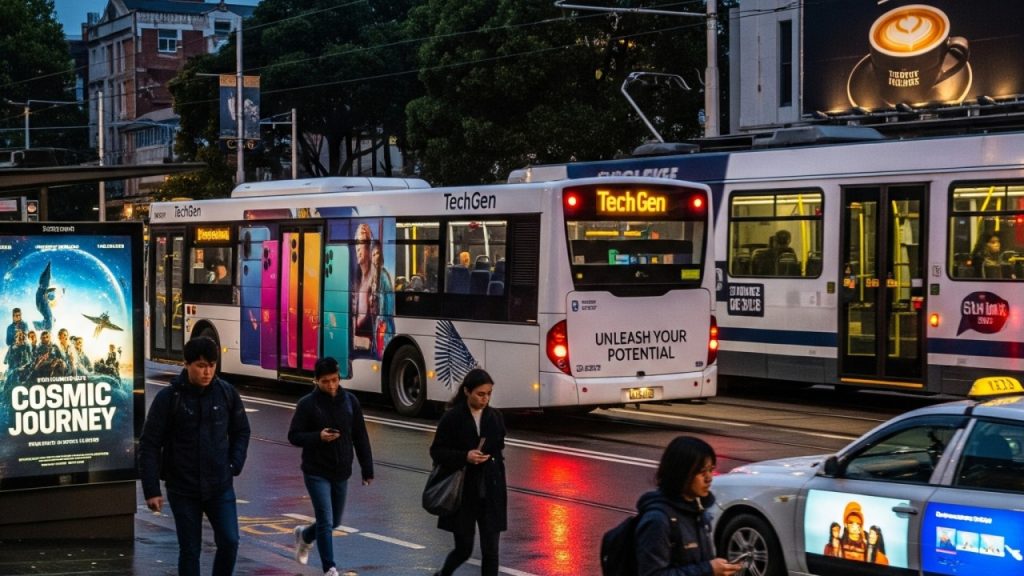
Buses, however, are dynamic. They appear at different angles, in different lighting, and in different parts of the street. Because the human eye is biologically programmed to track movement, a bus ad forces the brain to “re-process” the image every time it enters the field of vision. This constant re-engagement prevents the mental fatigue associated with traditional outdoor media, ensuring that the frequency of exposure remains high-quality and impactful.
3. Captive Audiences and “Idle Time”
In cities like Mumbai, Bengaluru, or Delhi, traffic isn’t just a nuisance; it’s a way of life. For a driver stuck behind a bus or a pedestrian waiting at a signal, that bus’s rear panel is the only thing to look at for 60 to 90 seconds at a time.
This is “Idle Time” advertising. Unlike a 5-second YouTube skip, the viewer has nowhere else to go. High frequency in these high-dwell areas means your message is being absorbed during a period of low mental resistance. When the brain is idle, it is more likely to encode information into long-term memory, leading to much higher spontaneous recall when that person later stands in a grocery aisle.
4. The “Big Brand” Perception
There is a psychological weight to bus advertising especially Full Wraps. When a consumer sees a brand physically dominating a public vehicle multiple times a week, they subconsciously categorize that brand as “established” and “successful.”
Frequency reinforces this perception of scale. If a shopper sees your ad on five different buses throughout their day, they assume your brand is “everywhere.” This creates a sense of market leadership that smaller, digital-only brands struggle to replicate. In the mind of the consumer, a brand that can “own the streets” is a brand that can be trusted.

5. Multi-Touchpoint Synergy
In 2026, bus advertising doesn’t live in a vacuum. It acts as the “physical anchor” for digital campaigns.
-
The Frequency Loop: A shopper sees your bus ad on their way to work (Touchpoint 1). They see it again during lunch while walking to get coffee (Touchpoint 2). That evening, when they see a sponsored post for the same brand on Instagram, the “frequency” of the physical world validates the digital ad.
-
Research shows that consumers are four times more likely to engage with a digital ad if they have already been exposed to the brand’s physical OOH (Out-of-Home) advertising multiple times.
The ROI of Repetition
Advertisers often worry about “overexposure,” but in transit media, the “wear-out” effect is incredibly low. Because buses move through different neighborhoods and interact with different crowds, the frequency feels organic rather than intrusive.
For a brand, the ROI of frequency is measured in Reduced Customer Acquisition Cost (CAC). When a customer is already familiar with your name because they’ve seen it on their daily commute for a month, you don’t have to “sell” them on who you are you only have to tell them what you’re offering.
Conclusion
Frequency is the heartbeat of brand recall. By placing your brand on the side of a bus, you aren’t just buying space; you’re buying a recurring role in the daily life of your customer. In a world of fleeting digital impressions, the consistent, physical presence of a bus ensures that when the time comes to make a purchase, your brand is the first one that “drives” into their mind.