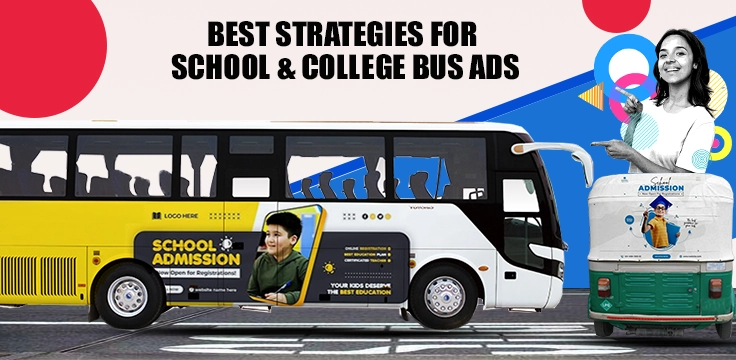

Every year, the “Admission War” in urban India sees schools and universities spending crores on digital marketing. However, the most successful institutions in 2026 are those that balance their online presence with high-impact bus advertising. Because education is a high-involvement purchase one that involves the entire family it requires multiple “trust touchpoints.” Bus branding provides the physical proof of an institution’s presence in the real world.
1. Dominating the “Student Corridor”
Every city has specific routes that act as academic veins roads lined with schools, tuition hubs, and stationary markets. By selecting bus routes that specifically ply these “Student Corridors,” institutes can achieve 100% audience relevance.
If your college is in North Delhi, branding the DTC buses that move through Civil Lines, Kamla Nagar, and Model Town ensures your message is seen by the exact demographic most likely to apply. This geographic precision prevents “wasted reach” and puts your brand in front of students exactly when they are in an academic frame of mind.

2. Building Parental Trust through “Physical Authority”
For an Indian parent, an educational institute isn’t just a service; it’s an investment in their child’s future. Digital ads can sometimes feel “virtual” or fleeting. However, seeing a massive, professionally designed bus wrap featuring top rankers, campus infrastructure, and university affiliations creates a sense of Institutional Stability. In 2026, OOH (Out-of-Home) is a primary driver of “Brand Credibility.” When a parent sees your institute’s name on a public bus daily, it signals that the school is a reputable, established part of the city’s social fabric.
3. High-Recall Placement: The Back Panel Advantage
The most valuable real estate on a bus for an educational brand is the Back Panel. Why? Because school and college ads often contain details admission dates, website URLs, or specific course lists.
When a parent is stuck in a 60-second traffic jam behind a bus, the back panel provides a “long-dwell” opportunity. Unlike a side wrap that flashes past, the back panel allows the viewer enough time to:
-
Note down a contact number.
-
Scan a QR Code to download a prospectus.
-
Read a testimonial from a top-performing student.
4. Capturing the “Captive” Interior Audience
While exterior branding builds awareness, Interior Bus Branding is for deep engagement. Millions of students travel by bus to their existing schools or coaching centers every morning.
Placing posters or digital screens inside the bus allows you to speak directly to the student for 20–30 minutes. This is the perfect space for:
-
Highlighting scholarship programs.
-
Showcasing extracurricular achievements.
-
Announcing “Open House” or “Campus Tour” dates.
5. Leveraging the “Phygital” Funnel
In 2026, bus branding for admissions isn’t a dead-end medium. Leading universities are now using NFC-enabled decals and AR (Augmented Reality) wraps. A student at a bus stop can point their phone at a branded bus to see a 360-degree virtual tour of the campus or watch an inspiring video from the Dean. This “Phygital” approach moves the student from “seeing an ad” to “starting an application” in less than a minute.

6. Seasonal Timing and Visual Storytelling
Education marketing is highly seasonal. The most effective campaigns follow a 3-Phase Strategy:
-
Phase 1 (January–February): Awareness wraps focusing on “Academic Excellence” and rankings.
-
Phase 2 (March–April): High-urgency “Admissions Open” messaging with clear Call-to-Actions (CTAs).
-
Phase 3 (May–June): Last-call reminders and scholarship highlight campaigns.
By changing the creative to match the academic calendar, institutes maintain a fresh “story” on the streets throughout the recruitment cycle.
Conclusion
Admissions are built on a foundation of visibility and trust. Bus Branding for educational institutes provides the scale to be visible and the physical presence to be trusted. In 2026, the institutions that are “everywhere” in the digital world and “everywhere” on the city streets are the ones that consistently meet their enrollment targets. To win the admission race, you need to meet the students and parents where they are on the move.