
In the boardroom of any growing Indian brand today, the conversation is shifting. We’ve all seen the reports: digital ad costs are skyrocketing, and “scroll blindness” is at an all-time high. In 2026, a 15-second Reel is lucky to get 3 seconds of attention. But a 40-foot bus? That’s an entirely different story.
As urban India becomes denser and our commutes become longer, bus branding has re-emerged not just as a support medium, but as a primary growth driver. Here’s the “boots-on-the-ground” reality of why this moving media is currently outperforming digital-only strategies.
1. The Death of the “Skip” Button
The biggest challenge for marketers in 2026 is “Zapping” the habit of immediately closing or scrolling past an ad. You can zap a YouTube ad. You can ignore a sponsored post. But when you are stuck behind a BEST or DTC bus at a red light for 120 seconds, you are a captive audience.
A bus is “Unskippable” in the truest sense. It doesn’t ask for your attention; it occupies your physical space. For a brand, this means you aren’t fighting an algorithm for a slot; you are owning a piece of the city’s visual real-time landscape.

2. High-Frequency “Memory Imprinting”
Buying a house, choosing a school, or even picking a new detergent doesn’t happen after seeing one ad. It happens after repeated exposure. Bus routes are the heartbeat of the city. They are predictable. If a commuter takes the same route from Indiranagar to Whitefield every morning, and they see your brand’s bus at 9:15 AM every single day, you are achieving “Memory Imprinting.” By the time they need your service, your brand isn’t a choice; it’s a familiar neighbor. This is the “Rule of 7” (seeing a brand seven times before buying) played out on the streets.
3. The “Authority Bias”: Why Size Matters in India
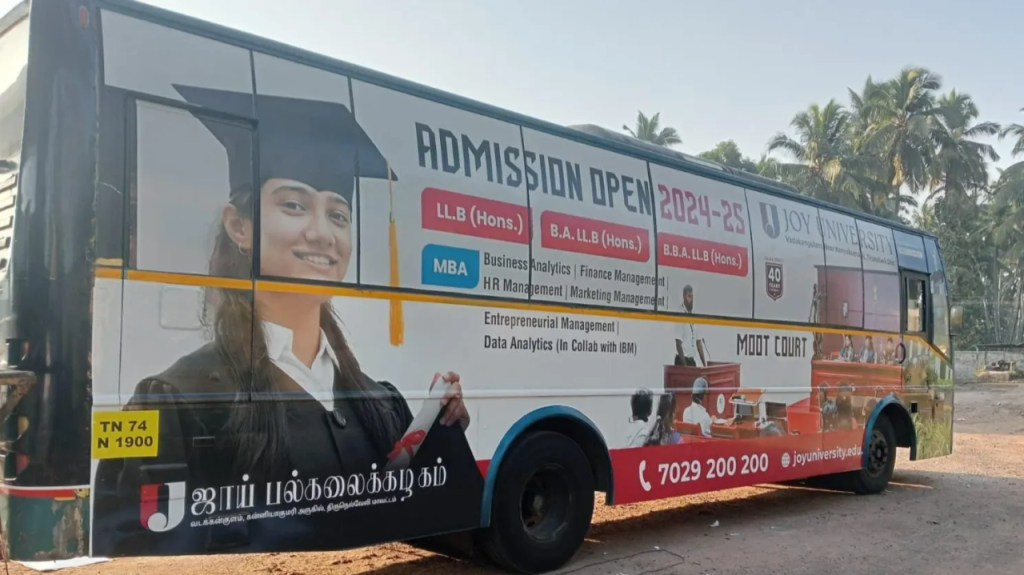
In the Indian consumer’s psyche, there is a subconscious link between physical size and brand trust. A startup that only exists on a smartphone screen can feel “fragile.” But a brand that wraps a 15-ton city bus signals scale, stability, and authority. For sectors like Real Estate and Fintech, where trust is the primary currency, the sheer physical dominance of a full bus wrap acts as a “Social Proof.” It tells the market: “We are big enough to own the streets, so we are big enough to handle your money/future.”
4. The 2026 Tech Integration: Data-Backed Mobility
We’ve moved past the era of “dumb” billboards. In 2026, bus branding is a high-tech game.
-
GPS-Optimized Routes: We now pick buses based on the “Wealth Heatmap” of the city. If you’re a luxury brand, your buses stay in South Mumbai or South Delhi.
-
The QR-to-Cart Pipeline: Modern wraps feature oversized, high-contrast QR codes that are specifically designed for the distance between a car window and a bus panel. One scan at a signal, and the product is in the user’s cart.
5. Beating the “Digital Noise” in Tier-2 Cities
The real growth story of 2026 is happening in cities like Jaipur, Lucknow, and Indore. In these markets, digital ad space is cluttered, but the “Transit Landscape” is still premium. Bus branding in these cities offers a much higher ROI (Return on Investment) because the “Share of Voice” is higher. Your branded bus isn’t just one of a thousand ads; it is the event on the road.
6. The “Green” Halo Effect
As India rolls out thousands of Electric Buses (e-buses) in 2026, where a brand chooses to place its ad matters. Advertising on an e-bus isn’t just a media buy; it’s a PR move. It aligns your brand with sustainability and progress. For the modern, eco-conscious Indian consumer, this “Green Association” is often the tie-breaker in their buying decision.
Conclusion
The secret to business growth in 2026 isn’t about finding more people; it’s about finding people when they have the time to look. Bus branding works because it turns the “dead time” of a commute into a high-impact brand experience. It is large, it is local, and it is impossible to ignore. In the race for the consumer’s wallet, the brands that move with the people are the ones that stay in their minds.