Why Mall Ads Need to Stop Selling and Start Playing
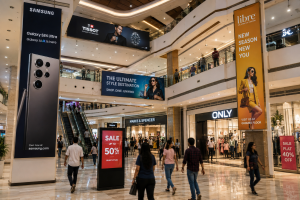
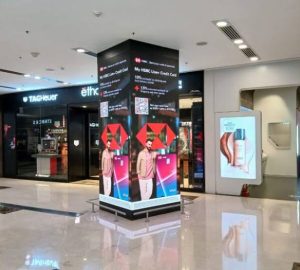
Let’s be brutally honest for a second. When was the last time you actually looked I mean really looked at a static poster in a shopping mall? If you’re like 99% of the population, you probably didn’t. We’ve become professional “ad-avoiders.” We have a sixth sense for tuning out anything that looks like it’s trying to sell us a $40 candle or a new pair of khakis.
For a long time, mall advertising was a passive game. You buy the space, you slap up a high-res photo of a celebrity, and you hope for the best. But in 2026, hope isn’t a strategy. Modern shoppers, especially the younger cohorts who grew up with a “Skip Ad” button practically etched into their retinas, don’t want to be talked at. They want to be part of the story.
If you want to win in the modern mall, you have to stop thinking like a media buyer and start thinking like an experience designer. Here’s the “human” way to do it.
1. The “Wait, How Did It Do That?” Factor
The best interactive ads don’t feel like ads; they feel like magic tricks. I’m talking about Anamorphic 3D Displays. You’ve probably seen the videos of the giant lions or waves crashing out of screens in Tokyo or New York.
When you bring that into a mall atrium, something shifts. People stop walking. They pull out their phones. They film it. They’ve just done your job for you they’re distributing your ad to their 500 followers for free. Why? Because it gave them a “wow” moment. It wasn’t a sales pitch; it was a free 15-second show.

2. Stop Guessing, Start Sensing
We’ve all seen those “Smart Kiosks” that just show a map. Boring. The “human” upgrade is Computer Vision for Mood. Imagine a digital screen for a skincare brand that doesn’t just loop a video. Instead, it uses a camera (anonymized, obviously privacy is a big deal) to detect the general “vibe” of the person standing there.
Are they looking tired? The screen suggests a refreshing eye cream and points them toward a 5-minute “recharge station” in the store. Are they smiling? It shows them the latest bright summer collection. It’s personalized without being creepy, and it feels like the brand is actually looking at you, not just shouting into the void.
3. The AR “Digital Scavenger Hunt”
One of the biggest problems malls face is “dead zones” those quiet corridors where nobody seems to go. Instead of letting that space go to waste, turn it into a game.
Using Augmented Reality (AR), brands can host treasure hunts. You see a sign: “There’s a digital dragon hiding in this wing. Find him for a 20% discount.” Suddenly, you’ve got a family of four walking through the quietest part of the mall, phones out, laughing, and hunting for a virtual creature. By the time they find it, they’re standing right in front of the store that sponsored the game. It’s clever, it’s low-cost compared to a full renovation, and it actually moves feet.
4. Let Them Be the Designer
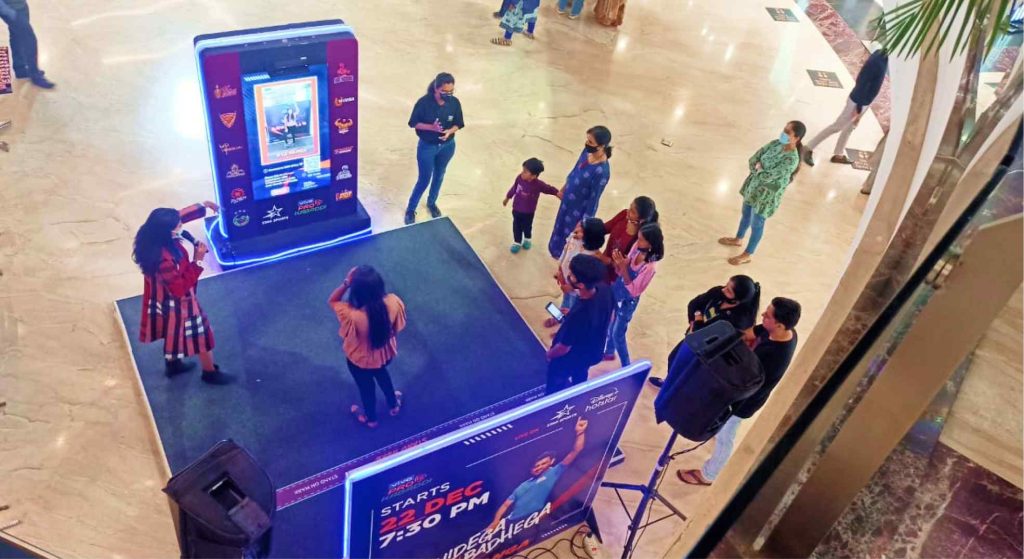
People love themselves. We love our faces, our styles, and our opinions. Use that! Interactive Voting Stations are incredibly underrated.
Set up a massive LED wall and ask a simple question: “Which color should we drop this Friday?” Let people tap a giant button on a screen to vote. When the vote count goes up in real-time, it creates a weirdly satisfying sense of community. You aren’t just a shopper; you’re a consultant for the brand. That psychological “buy-in” is worth way more than a clicked banner ad.

Why “Interactive” is the Only Way Forward
The “Old Guard” of marketing will tell you that interactive tech is too expensive or that “people just want to shop.” They’re wrong.
Shopping today is 10% utility and 90% entertainment. If I just wanted the product, I’d order it from my couch while wearing pajamas. I came to the mall advertising for the lights, the people, the smells, and the experience. If your advertising doesn’t contribute to that experience, it’s just visual pollution.
The Real Secret: Data with a Smile
The “dirty secret” of interactive ads is that they are the best data collectors on the planet. When someone plays an AR game or votes on a color, they’re giving you a goldmine of info. You know what they like, how long they stayed, and what captured their interest. But unlike an intrusive tracking cookie on a website, they gladly gave you that info because they got something fun in return.
That’s the “human” exchange: Value for Value.
Conclusion
The malls that are thriving in 2026 aren’t the ones with the most stores; they’re the ones that feel like a neighborhood hangout. To fit into that world, your advertising has to have a personality. It has to be a little bit playful, a little bit helpful, and a whole lot of “look at this!”
Next time you’re planning a campaign, ask yourself: “Would I stop my scrolling for 30 seconds to play with this?” If the answer is no, go back to the drawing board. It’s time to make mall ads fun again.