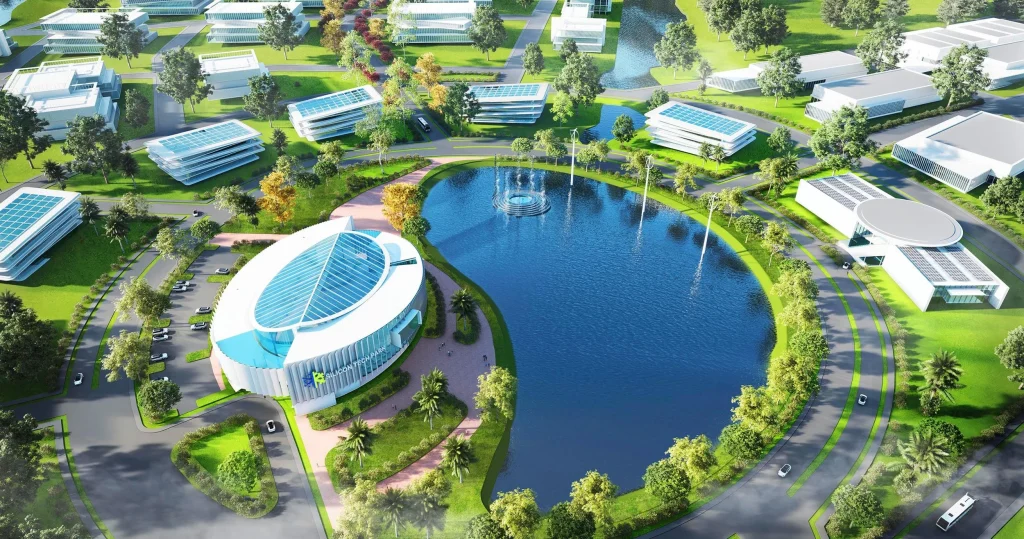

The competition for global innovation leadership increasingly revolves around tech parks. Across the United States, Europe, and Asia, governments and enterprises are investing heavily in purpose-built technology districts to attract startups, talent, and capital. While each region follows a different model, all share the same objective: to create scalable ecosystems where ideas move quickly from research to commercial success. This global comparison explores how tech parks across regions compete—and differentiate themselves—in shaping the future of innovation.
The United States: Startup Velocity and Venture Capital Scale
Tech parks in the US are defined by speed, risk-taking, and access to capital. The American model prioritises entrepreneurship, private investment, and rapid commercialisation.
Silicon Valley – The Benchmark for Startup-Led Innovation
Silicon Valley remains the global reference point for tech parks. Its ecosystem thrives on venture capital density, serial entrepreneurship, and strong university-industry ties. As a result, innovation cycles are extremely fast, particularly in software, AI, and platform businesses.
Seattle Tech Corridor – Enterprise and Cloud Dominance
Seattle’s tech parks benefit from the presence of global technology giants. These hubs focus on cloud computing, enterprise software, and AI at massive scale. Consequently, innovation here often scales globally from day one.
US Advantage:
-
Deep venture capital pools
-
Strong startup culture
-
Rapid go-to-market execution
US Limitation:
-
High operating costs
-
Talent competition driving wage inflation
Europe: Regulation-Led Innovation and Industry Integration
European tech parks focus on stability, regulation, and collaboration between startups, enterprises, and governments. While growth may be slower, sustainability and trust are higher.
London – FinTech and AI Within a Regulated Framework
London’s tech parks integrate finance, AI, and regulatory access. Startups benefit from proximity to global banks and regulators. Therefore, fintech and enterprise SaaS firms scale securely across Europe.
Berlin Tech Ecosystem – Startup Creativity and Cost Advantage
Berlin’s innovation districts attract founders due to lower costs and strong creative culture. While capital is more conservative, collaboration is high. As a result, Berlin excels in consumer tech and creative platforms.
Europe Advantage:
-
Strong regulatory trust
-
Easier cross-border EU expansion
-
Emphasis on ethical and sustainable tech
Europe Limitation:
-
Slower funding cycles
-
Fragmented language and market dynamics
Asia: Scale, Speed, and State-Supported Innovation
Asian tech parks operate at unmatched scale, often backed by strong government policy and long-term industrial planning. Innovation moves rapidly from research to production.
Zhongguancun Science Park – AI and Semiconductor Powerhouse
Zhongguancun anchors China’s AI, semiconductor, and deep-tech ambitions. Unlike Western models, it integrates research, manufacturing, and policy support. As a result, technologies scale faster into mass deployment.

Singapore – Digital Economy Gateway
Singapore’s tech parks combine regulatory clarity, global connectivity, and advanced infrastructure. They act as regional headquarters for companies expanding across Southeast Asia. Therefore, innovation here scales regionally rather than domestically.
Tokyo – Robotics and Smart City Leadership
Tokyo’s tech parks focus on robotics, electronics, and smart city systems. Innovation is deeply integrated into urban life. Consequently, Tokyo leads in real-world technology deployment rather than experimental growth.
Asia Advantage:
-
Government-backed scale
-
Faster infrastructure rollout
-
Strong hardware and manufacturing integration
Asia Limitation:
-
Regulatory opacity in some markets
-
Limited openness in certain innovation ecosystems
Key Differences in Global Tech Park Models
Innovation Speed vs Stability
US tech parks prioritise speed and disruption. In contrast, European parks emphasise compliance and long-term stability. Meanwhile, Asian parks balance speed with state-backed planning.

Startup vs Enterprise Focus
American ecosystems lean heavily toward startups. European tech parks balance startups with enterprises. Asian tech parks often prioritise national champions and industrial-scale innovation.
Research-to-Market Path
Asia excels in converting research into production. The US dominates in commercialising digital platforms. Europe leads in regulated innovation such as fintech, healthtech, and climate tech.
Who Leads the Global Innovation Race?
There is no single winner. Instead, leadership depends on the sector:
-
AI & Platforms: United States
-
FinTech & RegTech: Europe
-
Semiconductors & Deep-Tech Manufacturing: Asia
-
Smart Cities & Robotics: Asia (Japan, Singapore)
As global challenges grow more complex, collaboration between these ecosystems will matter more than competition alone.
Conclusion: The Future of Global Tech Parks
In conclusion, tech parks across the US, Europe, and Asia compete through distinct innovation philosophies. The US leads with speed and capital, Europe with trust and regulation, and Asia with scale and execution. Together, these ecosystems define the future of global innovation. As technology becomes more interconnected, the most successful tech parks will be those that combine global collaboration with regional strengths.