
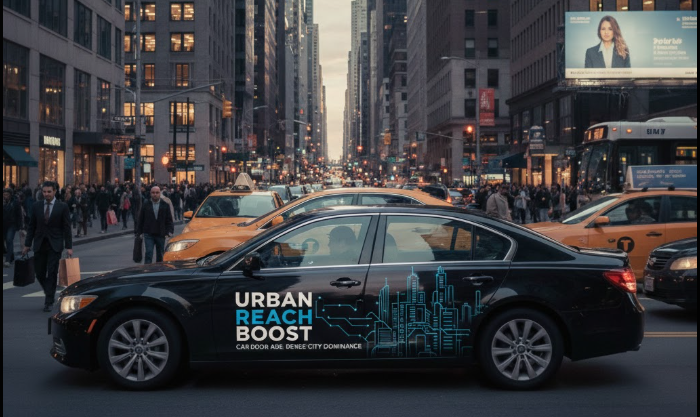
In highly congested urban environments, brands face increasing difficulty in gaining consistent consumer attention. Traditional outdoor advertising formats such as hoardings, unipoles, and billboards often struggle with visibility due to traffic congestion, visual clutter, and limited dwell time. As cities grow denser, marketers are actively seeking more flexible and high-impact alternatives. This is precisely where car door branding offers better urban reach than static OOH in dense city markets.
Unlike fixed outdoor media, car door branding transforms everyday vehicles into moving advertisements. As a result, brands gain dynamic exposure across residential streets, commercial zones, corporate hubs, and high-footfall areas. Consequently, this format delivers continuous impressions throughout the day without being restricted to a single location.
Understanding Car Door Branding in Urban Advertising
Car door branding involves placing brand creatives on the doors of cars, taxis, app-based cabs, or fleet vehicles. These branded vehicles move across multiple neighborhoods daily, thereby ensuring widespread visibility.
Moreover, urban commuters spend significant time in traffic. Because of this, branded cars remain within sight for longer durations. In contrast, static hoardings are often passed within seconds, reducing recall value.
Therefore, in compact city ecosystems, mobility plays a decisive role in advertising effectiveness.
Why Car Door Branding Offers Better Urban Reach Than Static OOH in Dense City Markets
One of the strongest reasons car door branding offers better urban reach than static OOH in dense city markets is its ability to overcome location dependency.
Static OOH depends entirely on site placement. If the hoarding is blocked, poorly lit, or positioned beyond eye level, visibility drops instantly. However, car door branding moves with traffic and integrates naturally into the urban commute cycle.
Additionally, vehicles travel through:
-
Residential colonies
-
Office districts
-
Shopping streets
-
Metro station zones
-
Market areas
As a result, a single branded car can outperform one static hoarding in daily exposure.
Higher Frequency and Repeated Brand Impressions
Urban advertising success depends heavily on repetition. Consumers rarely convert after a single exposure. Instead, they respond after repeated brand encounters.
Car door branding ensures this frequency naturally. Since vehicles operate daily on fixed and flexible routes, residents often see the same brand multiple times a week. Over time, this repetition builds strong brand familiarity.
On the other hand, static OOH relies on chance viewing. If a consumer does not pass that route, the advertisement fails to deliver impact.
Thus, repetition makes mobile branding significantly more efficient in dense markets.
Cost Efficiency Compared to Static Outdoor Media
Another critical advantage is cost-effectiveness. Premium hoardings in metro cities demand high rentals, long-term commitments, and additional printing costs.
In contrast, car door branding offers:
-
Lower entry cost
-
Flexible campaign duration
-
City-wide reach without multiple site bookings
Furthermore, brands can scale campaigns by simply increasing vehicle count rather than negotiating new locations.
Therefore, when evaluating cost per impression, mobile branding consistently delivers stronger ROI.
Better Visibility at Eye Level
One major limitation of static OOH is elevation. Billboards are usually placed high above ground level, which reduces clarity and recall.
Car door branding, however, appears directly at eye level. Pedestrians, motorists, and passengers can read the message clearly while waiting at signals or stuck in traffic.
Because urban congestion increases stoppage time, brand exposure duration increases automatically. Consequently, message retention improves significantly.
Enhanced Hyperlocal Targeting
Modern marketing strategies demand hyperlocal precision. Brands no longer want generic city-wide visibility alone. Instead, they aim to target specific zones.
Car door branding allows route-based deployment. Campaigns can focus on:
-
IT corridors
-
Educational hubs
-
Retail clusters
-
Residential societies
-
Event-heavy zones
Hence, advertisers can align mobility routes with audience demographics, something static hoardings cannot achieve easily.
Greater Engagement in High-Traffic Urban Conditions
Ironically, traffic congestion — often a challenge — becomes an advantage for mobile advertising.
When vehicles halt at traffic signals, branded car doors remain visible for extended periods. During this time, commuters subconsciously absorb visuals, taglines, and brand colors.
As a result, engagement improves without additional media spend.
This explains why car door branding offers better urban reach than static OOH in dense city markets, where traffic volume remains consistently high.
Ideal Format for Modern Urban Brands
Car door branding works exceptionally well for:
-
App-based platforms
-
Food delivery brands
-
Real estate launches
-
Retail promotions
-
OTT platforms
-
Local service providers
Because urban audiences associate movement with modernity, mobile ads appear more relevant and contemporary than static billboards.
Thus, brands seeking agility and modern visibility increasingly prefer this format.
Measurable and Scalable Campaign Performance
Unlike traditional hoardings, car branding campaigns allow performance tracking through:
-
Route mapping
-
Vehicle count analysis
-
Duration-based exposure
-
City-zone coverage
Moreover, advertisers can scale campaigns instantly based on performance insights.
This adaptability further strengthens its dominance in dense metropolitan environments.
Conclusion
As Indian cities continue to expand vertically and horizontally, advertising formats must evolve accordingly. Static OOH still holds value; however, its limitations become more evident in crowded urban ecosystems.
In comparison, car door branding offers better urban reach than static OOH in dense city markets by delivering mobility, frequency, cost efficiency, and hyperlocal exposure. By integrating seamlessly into daily traffic movement, it ensures consistent brand presence where consumers actually spend their time.
For brands aiming to dominate city landscapes without excessive media costs, car door branding stands out as a powerful and future-ready urban advertising solution.