
India’s ride-hailing ecosystem has evolved beyond transportation. Today, mobility platforms are powerful advertising ecosystems. From Cab Exteriors to In-Ride Screens: Ola’s Multi-Format Advertising Strategy Explained explores how Ola has built a layered advertising model that reaches consumers both outside and inside the ride.
Instead of relying on a single format, Ola integrates multiple advertising touchpoints across the commuter journey. As a result, brands gain continuous visibility—from the moment a cab enters traffic to the time a passenger reaches their destination.
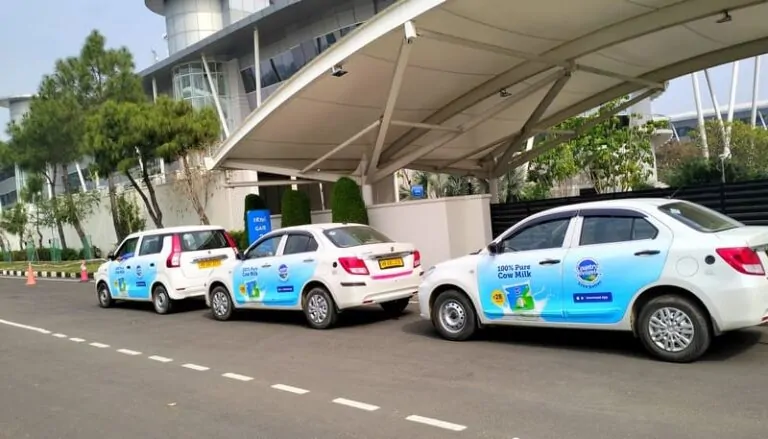
The Foundation: Cab Exterior Branding as Moving Billboards
Cab exteriors form the most visible layer of Ola’s advertising strategy. Branded doors, back panels, and full wraps transform everyday cabs into moving billboards.
Because Ola cabs operate across business districts, residential areas, airports, and commercial hubs, exterior branding ensures city-wide exposure. Moreover, traffic congestion increases dwell time at signals and intersections. Therefore, pedestrians and motorists repeatedly see the same creative, improving brand recall.
This format works especially well for FMCG, fintech, app-based services, and entertainment launches that require mass visibility.
From Cab Exteriors to In-Ride Screens: Ola’s Multi-Format Advertising Strategy Explained
What differentiates Ola is its ability to extend advertising beyond the street and into the ride itself. While exterior branding captures attention externally, interior formats engage a captive audience.
By combining outdoor visibility with in-cab engagement, Ola offers advertisers a full-funnel media solution. Consequently, awareness, consideration, and action can all happen within a single commute.
In-Cab Panels and Seat-Back Branding
Once passengers step inside an Ola cab, interior panels become powerful engagement tools. Seat-back posters, dashboard panels, and window stickers allow brands to communicate detailed messaging.
Since riders spend uninterrupted time inside the vehicle, message retention improves. Additionally, passengers are more receptive during idle commute moments. Hence, interior branding complements exterior visibility by reinforcing the message.
This format is often used by education platforms, fintech apps, OTT platforms, and healthcare brands that need explanation-driven communication.

In-Ride Digital Screens: Captive and Contextual Engagement
One of Ola’s most impactful innovations is in-ride digital screens. These screens display short videos, static ads, and interactive content during the journey.
Because passengers cannot skip these screens easily, engagement rates are significantly higher than standard digital ads. Moreover, content can be contextual—time-based, city-specific, or offer-driven.
As a result, advertisers deliver storytelling rather than simple impressions. This makes in-ride screens ideal for product demos, app walkthroughs, and promotional offers.
QR Codes and Performance-Driven Integration
Ola’s multi-format strategy also bridges offline exposure with digital action. QR codes placed on seat-backs or screens lead passengers to landing pages, app downloads, or exclusive discounts.
Since riders have time to scan and explore, conversion probability increases. Therefore, Ola advertising is not just about visibility—it is performance-enabled mobility media.
Brands often integrate these formats with influencer, social, and app campaigns for amplified impact.
Hyperlocal and City-Level Customisation
Another strength of Ola’s advertising ecosystem is hyperlocal execution. Campaigns can be customised by city, zone, or route.
For example, a retail brand may promote mall offers on routes near shopping districts, while a fintech brand may focus on office corridors. This geographic precision reduces media waste and increases relevance.
Consequently, advertisers speak directly to city-specific audiences rather than running generic national creatives.
Data, Tracking, and Accountability
Ola’s advertising formats are backed by data. GPS tracking, ride frequency, route mapping, and photo audits provide transparency.
Additionally, in-ride screen campaigns offer impression counts and engagement metrics. As a result, brands gain accountability comparable to digital media while enjoying the scale of outdoor advertising.
This blend of data and physical visibility makes Ola’s platform attractive to both large brands and emerging startups.
Industries Leveraging Ola’s Multi-Format Advertising
Several sectors actively use Ola’s advertising ecosystem:
-
FMCG & Retail: High-frequency exterior branding
-
Fintech & Apps: In-ride screens with QR-based actions
-
OTT & Entertainment: Trailer and show promotion
-
Education & EdTech: Detailed interior messaging
Because Ola covers multiple touchpoints, campaigns remain visible throughout the commute cycle.
The Future of Mobility-Led Advertising
From cab exteriors to in-ride screens, Ola has created a layered media environment that aligns with modern urban behavior. As commute times increase and attention fragments across screens, mobility media fills a critical gap.
Ola’s multi-format advertising strategy proves that the future of outdoor advertising is not static—it is mobile, measurable, and immersive.
Conclusion: One Ride, Multiple Brand Touchpoints
From Cab Exteriors to In-Ride Screens demonstrates how Ola has transformed everyday commutes into high-impact advertising journeys. By combining moving billboards with captive digital engagement, Ola offers brands unmatched frequency and relevance.
In a crowded media landscape, the smartest brands are not just advertising where people look—they are advertising where people move.