How Do Brands Use Anamorphic Billboards to Create Immersive, Illusion-Based Experiences That Boost Audience Engagement?
Imagine walking through a busy city square when suddenly a tiger seems to leap out of a billboard, or a smartphone floats in midair before spinning toward you. These aren’t scenes from a movie — they’re the stunning results of anamorphic billboard advertising, a breakthrough in 3D outdoor display technology that’s transforming how brands engage audiences in real time.
The Magic of the Anamorphic Illusion
At its core, anamorphic design uses a clever optical illusion to make 2D visuals appear three-dimensional when viewed from a specific angle. The trick lies in perspective — the artwork is intentionally distorted so that, when projected on large LED screens, it appears to have depth and motion.
The result? Viewers feel like they’re part of a live cinematic moment, not just looking at another ad. This sense of realness and surprise is what makes anamorphic billboards such powerful storytelling tools.

How Brands Leverage Anamorphic Billboards for Engagement
1. Turning Public Spaces into Immersive Theatres
Brands are reimagining city intersections, shopping districts, and transit hubs as open-air stages. By using anamorphic 3D billboards, they turn everyday locations into immersive entertainment zones. This physical-digital fusion encourages people to pause, record, and share the spectacle — turning a few seconds of attention into millions of online impressions.
Example: Coca-Cola’s 3D billboard in New York’s Times Square featured dynamic waves and floating bottles, transforming a static display into a moving brand experience.
2. Creating Emotion Through Realism and Motion
Anamorphic billboards excel at storytelling. A sneaker doesn’t just appear — it flies off the screen. A car doesn’t just rotate — it drifts across the skyline. The combination of motion, perspective, and photorealistic rendering evokes genuine emotion, which leads to stronger audience connection and recall.
Example: Nike’s Air Max 3D billboard in Tokyo showed shoes bouncing against the screen’s edges, sparking viral reactions across social media.
3. Encouraging User-Generated Content and Virality
Perhaps the most valuable aspect of anamorphic displays is how they transform spectators into promoters. People naturally film and post these illusions online, giving brands free viral marketing. What begins as an outdoor campaign quickly becomes a digital engagement storm.
Each video shared adds layers of social proof — a crucial element in modern brand visibility.
4. Integrating Digital Storytelling and Interactivity
Forward-thinking brands are integrating anamorphic visuals with AR filters, QR codes, and gamified experiences. For example, viewers might scan a code on the screen to unlock behind-the-scenes content, exclusive offers, or interactive challenges, creating a continuous engagement loop from outdoor to mobile.
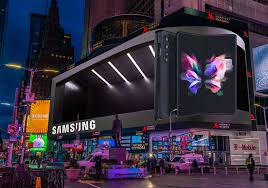
Example: Samsung’s Galaxy Z Fold campaign in London used 3D visuals of the phone opening up, while digital elements invited passersby to experience the fold virtually.
5. Elevating Brand Perception Through Innovation
Anamorphic billboards signal creativity, tech-forward thinking, and boldness — values that resonate with modern consumers. For brands, it’s not just about advertising a product; it’s about showcasing innovation itself.
When audiences associate a brand with awe and wonder, the emotional payoff translates into long-term loyalty and admiration.
The Result: Engagement That Feels Like Entertainment
Unlike traditional ads that rely on repetition, anamorphic billboards succeed by earning genuine attention. They transform outdoor advertising into a spectacle — where engagement is driven by emotion, curiosity, and delight.

In a digital-first world, this blend of immersive design, illusion-based storytelling, and audience participation is what helps brands cut through the noise.
As one industry expert put it:
“Anamorphic screens don’t sell — they seduce the audience into remembering.”