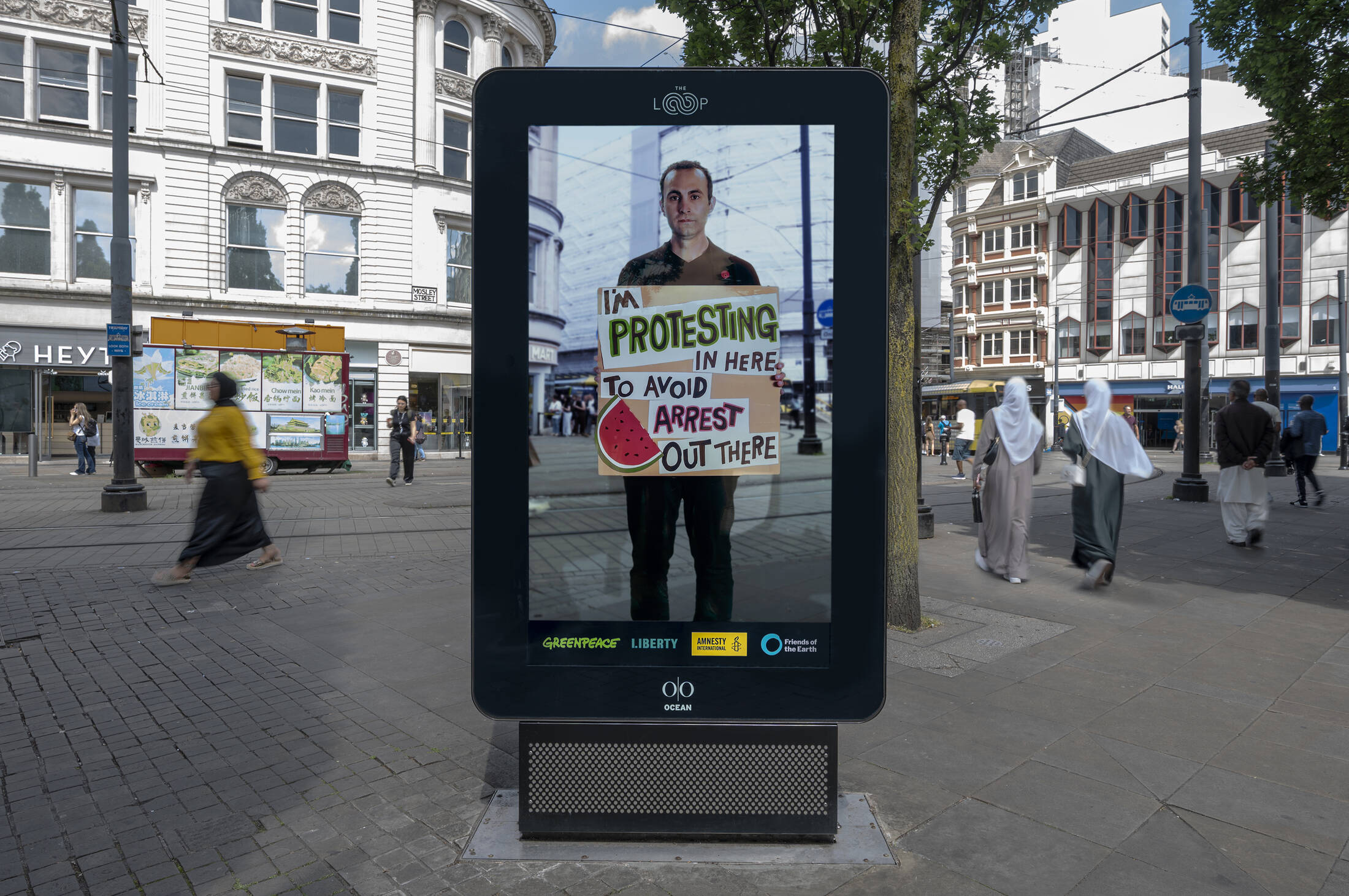
The Greenpeace “They Can’t Arrest This Billboard” campaign in the UK stands as one of the most provocative uses of digital out-of-home (DOOH) media in recent years. Designed as a protest-led outdoor execution, the campaign placed real Greenpeace activists inside digital billboards across multiple UK cities to spotlight concerns around tightening protest laws.
By turning billboards into live acts of resistance, Greenpeace redefined the role of outdoor media—from a commercial platform into a civic and political stage. As a result, the campaign sparked public debate, media coverage, and widespread conversation about freedom of expression and the right to protest.
The Core Insight: Protest Is Being Restricted, Visibility Is Not
At the heart of the Greenpeace “They Can’t Arrest This Billboard” campaign was a sharp legal and cultural insight. While new protest laws increasingly restrict physical demonstrations, advertising spaces—especially DOOH—remain protected zones for expression.
Greenpeace exploited this contrast brilliantly. If activists could not safely protest on the streets, they would protest inside billboards. Consequently, the campaign highlighted the tension between public dissent and legal control without resorting to violence or disruption.
This idea turned the medium itself into the message.
Real Activists Inside Digital Billboards
What made the campaign especially powerful was its authenticity. These were not actors or simulated visuals. Real Greenpeace activists appeared live or pre-recorded inside digital screens, holding placards and messages addressing protest rights.

The Greenpeace “They Can’t Arrest This Billboard” execution blurred the boundary between advertising and activism. Passersby were confronted with something unexpected: a protest happening in plain sight, yet legally untouchable.
This visual disruption forced attention, curiosity, and reflection—three outcomes rarely achieved simultaneously in outdoor advertising.
Multi-City DOOH Deployment Across the UK
The campaign ran across several major UK cities, using high-visibility DOOH placements in busy urban environments. These locations ensured maximum exposure among commuters, pedestrians, and media audiences.
Because the Greenpeace “They Can’t Arrest This Billboard” campaign appeared in everyday public spaces, it reached people who might not actively seek out political discourse. As a result, the message entered mainstream conversation rather than remaining confined to activist circles.
This scale transformed the campaign from a symbolic protest into a national statement.
Blending Activism With Outdoor Media
Traditionally, outdoor advertising is associated with brands, commerce, and entertainment. Greenpeace deliberately challenged this norm. By using DOOH as a protest medium, the organization reclaimed advertising infrastructure for civic expression.
The Greenpeace “They Can’t Arrest This Billboard” campaign demonstrated that OOH does not have to be neutral or commercial. Instead, it can function as a platform for democratic debate and public accountability.
This approach expanded the perceived role of DOOH within society.
Cultural and Media Impact
The campaign quickly generated earned media attention. News outlets, social platforms, and legal commentators discussed the tactic, its implications, and the issues it raised.
The Greenpeace “They Can’t Arrest This Billboard” campaign succeeded not because it asked for attention, but because it demanded discussion. The boldness of the execution ensured that the protest law conversation reached audiences far beyond the billboard locations.

Importantly, the campaign avoided shock for shock’s sake. Its provocation was rooted in a legitimate social issue, which gave it credibility and weight.
Why DOOH Was the Perfect Medium
DOOH was essential to the campaign’s logic. Static posters would not have conveyed urgency or presence. Digital screens allowed Greenpeace to simulate live protest, movement, and immediacy—key elements of activism.
The Greenpeace “They Can’t Arrest This Billboard” campaign also leveraged DOOH’s legal protection as advertising. This strategic use of the medium highlighted contradictions in how public space is regulated.
In this context, DOOH was not just a channel. It was the loophole.
Ethical Provocation and Brand Alignment
Greenpeace has long been associated with nonviolent direct action and creative protest. This campaign aligned seamlessly with the organization’s history and values.
The Greenpeace “They Can’t Arrest This Billboard” execution reinforced the brand’s identity as fearless, intelligent, and unafraid to challenge authority. At the same time, it maintained ethical clarity by focusing on rights, not disruption.
This balance ensured public sympathy rather than backlash.
Key Learnings for Brands, NGOs, and Media Owners
Key takeaways from this campaign include:
-
DOOH can function as a platform for activism, not just advertising
-
Real people increase credibility and emotional impact
-
Legal context can become part of the creative idea
-
Provocation works best when rooted in genuine issues
-
Outdoor media can shape public debate, not just awareness
These insights open new possibilities for purpose-driven communication.
Conclusion
The Greenpeace “They Can’t Arrest This Billboard” campaign is a landmark moment in the evolution of outdoor advertising. By placing real activists inside digital billboards, Greenpeace transformed DOOH into a protected protest space and forced a national conversation about civil liberties.
This campaign proves that outdoor media is not just about selling products or building brands. When used courageously, it can challenge power, question laws, and give visibility to voices that risk being silenced.