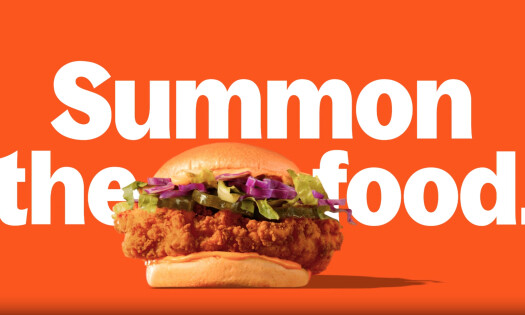
The Grubhub “Summon the Food” campaign in the U.S. is a bold demonstration of how physical creativity in outdoor advertising can trigger instant emotional—and appetitive—responses. By installing giant 3D food objects in and around bus stops and urban public spaces, Grubhub transformed everyday commutes into crave-worthy brand experiences.
Rather than relying on screens or copy-heavy messaging, the campaign leaned into visual spectacle. Oversized, hyper-realistic food items—such as melting grilled cheese sandwiches—became the hero, reminding passersby that food cravings can strike anytime, anywhere.
The Core Insight: Cravings Are Visual and Immediate
At the heart of the Grubhub “Summon the Food” campaign was a simple human truth: seeing food makes people want food. Cravings are often impulsive and visual, not rational. Grubhub used this insight to turn outdoor spaces into appetite triggers rather than information channels.

Instead of telling people to order food, the campaign showed them what they were missing. Consequently, the messaging felt intuitive and instinctive. Viewers did not need to read or interpret anything—the reaction was immediate.
This insight allowed Grubhub to bypass persuasion and go straight to desire.
Giant 3D Food as an Outdoor Attention Magnet
The most striking feature of the Grubhub “Summon the Food” campaign was its use of large-scale 3D installations. Oversized food elements were integrated seamlessly into urban infrastructure such as bus shelters, sidewalks, and waiting areas.
These installations stopped people in their tracks. The scale, texture, and realism made the food feel almost tangible. As a result, the campaign achieved something rare in outdoor advertising: prolonged attention and interaction.
People photographed the installations, posed with them, and shared them on social media—extending the campaign’s reach far beyond its physical locations.
Bus Stops and Urban Spaces as Contextual Canvases
Bus stops were a particularly smart placement choice. Waiting time naturally increases dwell time, making it the perfect environment for experiential outdoor advertising. The Grubhub “Summon the Food” campaign used this pause in motion to heighten anticipation and hunger.

Urban spaces added another layer of relevance. In busy city environments where food delivery is already part of daily life, the installations felt natural rather than forced. Consequently, the campaign blended into the rhythm of the city while still standing out visually.
This contextual alignment strengthened message recall and brand association.
Blending Physical OOH With Social Sharing
Although the campaign was firmly rooted in physical outdoor media, its impact was amplified digitally. The dramatic visuals encouraged organic social sharing, turning commuters into content creators.
The Grubhub “Summon the Food” installations became social media moments rather than static ads. This crossover highlighted a growing trend in OOH advertising: designing for the camera as much as for the street.
By doing so, Grubhub achieved earned media value without compromising the integrity of the physical experience.
Why Experiential Outdoor Worked for Grubhub
Food delivery is a highly competitive category. Most brands rely heavily on digital discounts and app-based messaging. Grubhub chose a different route by using experiential outdoor advertising to create emotional salience.
The Grubhub “Summon the Food” campaign reinforced the brand’s core promise—instant access to satisfying food—without showing an app screen or CTA-heavy copy. Instead, it relied on sensory appeal and memory creation.
Because outdoor advertising is non-skippable, the impact felt stronger and more immersive than a digital ad ever could.
Cultural Relevance and Urban Lifestyle Alignment
The campaign also aligned well with urban culture. City dwellers are constantly surrounded by stimuli, yet food remains one of the most universally appealing ones. By exaggerating food visuals to an almost playful level, Grubhub tapped into humor, indulgence, and everyday desire.
The Grubhub “Summon the Food” campaign embraced excess in a way that felt fun rather than overwhelming. This tone helped the brand appear approachable, modern, and culturally aware.
Key Learnings for OOH and Food Brands
Key takeaways from this campaign include:
-
Visual appetite triggers outperform rational messaging
-
3D installations dramatically increase dwell time
-
Bus stops are ideal for experiential OOH
-
Physical spectacle drives organic social sharing
-
Sensory-led creativity builds strong brand memory
These lessons are especially relevant for brands operating in high-frequency, impulse-driven categories.
Conclusion
The Grubhub “Summon the Food” campaign proves that outdoor advertising can be both playful and powerful when it engages human instincts. By integrating giant 3D food items into urban spaces, Grubhub turned everyday commutes into moments of craving, delight, and brand connection.
In an age dominated by screens, this campaign is a reminder that sometimes the most effective way to drive action is to make people feel hungry—right there on the street.