❝Branding is the art of becoming unforgettable in the minds of people.❞
In today’s fast-moving world, where every second counts, your brand must not just be seen but remembered. And what better place to connect with millions of urban commuters daily than India’s metro networks?
From Delhi to Bengaluru, Hyderabad to Mumbai, metros have transformed into more than just a transport system — they are a lifestyle hub, a moving canvas, and a powerful medium for advertisers. For brands aiming at high visibility, strong recall, and meaningful engagement, metro branding in India is no longer an option — it’s a necessity.
In this FAQ, we answer a crucial question every modern marketer asks:
👉 What are the different types of metro branding options available in India?
Let’s dive deep into the possibilities, opportunities, and best practices.
🌟 Why Metro Branding is the New Age Marketing Magnet
Before we explore types of branding, it’s important to understand why metro advertising is booming in India:
- Unmatched Reach: Over 10 million people commute via metros daily across Indian cities.
- Urban, Premium Audience: Young professionals, students, working-class families — the perfect mix for consumer brands.
- High Dwell Time: Unlike highways, metro commuters spend 10–30 minutes inside stations and trains, giving brands longer exposure.
- Non-Intrusive yet Impactful: Branding feels like part of the journey, not an interruption.
💡 Did you know? Delhi Metro alone carries more than 5 million passengers daily, making it one of the world’s busiest networks.

🚇 Different Types of Metro Branding Options in India
Here’s a comprehensive list of metro advertising spaces, explained in detail, with benefits, scenarios, and values.
1. Inside Train Branding
(“Turn every train into a moving billboard.”)
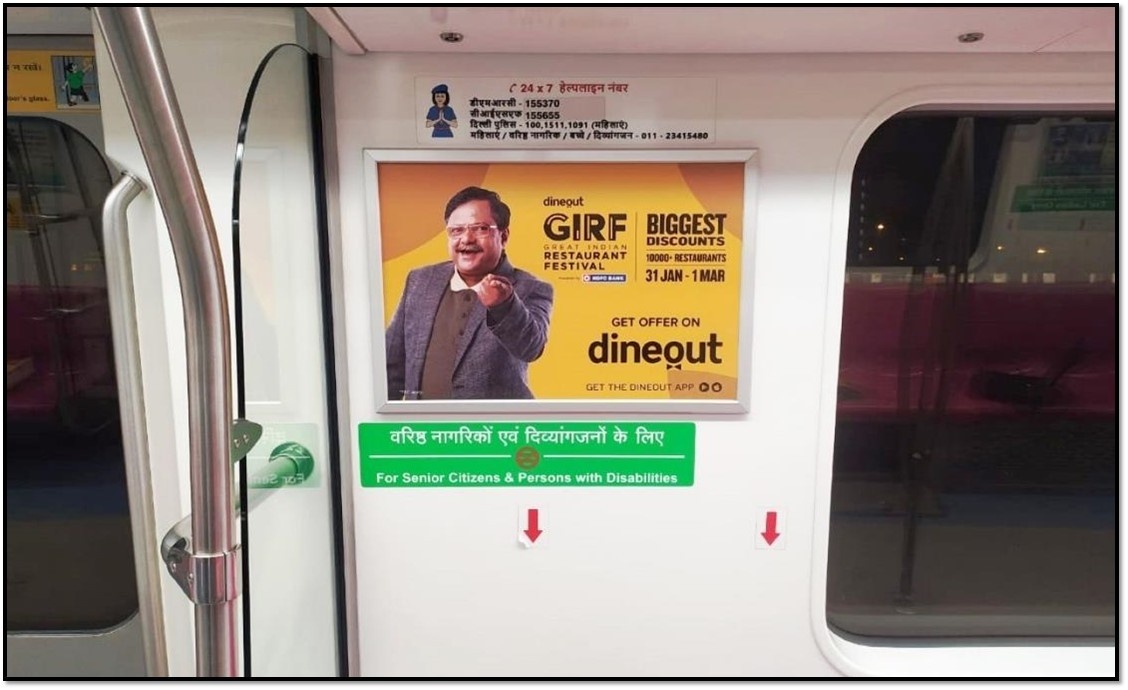
When a passenger steps inside a metro, the train itself becomes an immersive world. With inside branding, your message travels with the commuter every day.
- Options inside trains:
- Panel Wraps (above seats, walls, and windows)
- Grab Handle Branding (on handholds)
- Seat Back Branding (direct eye-level ads)
- Door Panel Branding (where passengers enter/exit)
- Digital Screens/LED Panels (video + interactive ads)
- Benefits:
- Continuous visibility for 10–30 minutes (average ride).
- Captive audience = better message retention.
- Perfect for lifestyle brands, e-commerce, fintech, and OTT apps.
👉 Example: A food delivery app branding the entire train interior with fun food graphics can trigger commuters to order instantly post-ride.
2. Train Wrap Advertising (Exterior Branding)
(“Where the city sees your story in motion.”)
The exterior of metro trains is a giant moving billboard visible across the city.
- Execution: Full or partial vinyl wraps covering train coaches.
- Impact: Seen by pedestrians, vehicles, and residents along metro routes.
- Best for: Large-scale campaigns, new product launches, political campaigns, banks, or telecom companies.
💡 Fun Fact: In Delhi Metro, a single fully wrapped 8-coach train can generate over 500,000 daily impressions.
3. Station Panels & Wall Branding
(“Walls that speak your brand.”)
Every station has high-traffic panels and wall spaces perfect for static or digital branding.
- Types:
- Backlit Posters
- Vinyl Wall Wraps
- Static Billboards
- Motion/LED Panels
- Locations: Ticket counters, escalators, waiting areas, corridors.
- Why it works:
- Passengers spend 5–15 minutes here daily.
- Gives brands large, uncluttered surfaces to narrate a story.
👉 Think of it as your own gallery where thousands walk through daily.
4. Entry/Exit Gate Branding
(“First impression, last impression.”)
Entry and exit gates are high-frequency touchpoints where passengers swipe their cards, pause, and notice ads.
- Options:
- Gate arch branding
- Sticker wraps
- Digital gates with LED screens
- Value: Commuters can’t avoid looking at gates; this ensures 100% visibility.
5. Platform Screen Doors & Safety Panels
(“Safety meets storytelling.”)
Modern metros like Delhi, Bengaluru, and Hyderabad use platform screen doors (PSDs) for safety. These doors double up as premium branding spaces.
- Benefits:
- Eye-level, high-impact placement.
- Perfect for luxury brands, banks, insurance, and government campaigns.
- Safety association builds positive emotional value for the brand.
6. Digital Advertising (LED, LCD, and Interactive Screens)
(“When static isn’t enough, go dynamic.”)
Digital screens inside metros create high recall with moving content.
- Formats:
- LED walls on station platforms.
- LCD panels inside coaches.
- Interactive touch screens (polls, games, QR code engagement).
- Why choose digital?
- Engages Gen Z and millennials.
- Can be updated in real time.
- Best for FMCG, entertainment, app-based companies.
7. Escalator & Stairway Branding
(“Every step tells your story.”)
Escalators and staircases see constant footfall. Branding here is eye-level and unavoidable.
- Options:
- Escalator panel wraps
- Stair riser branding
- Sidewall ads
- Perfect for: Retail stores, fashion outlets, gyms, electronics, and hyperlocal businesses.
8. Floor Graphics & Experiential Zones
(“Turn the floor beneath their feet into a canvas.”)
Creative brands use floor stickers and experiential zones inside stations.
- Examples:
- 3D floor graphics.
- Pop-up stalls for sampling or demos.
- Immersive tunnels with thematic decor.
💡 Brands like Coca-Cola and Netflix have used pop-ups in metro stations for experiential marketing.
9. Baggage Scanner & Security Check Branding
(“High dwell time, high visibility.”)
Every commuter passes through baggage scanners. This zone ensures slow-moving, high-attention branding.
- Execution: Vinyl wraps, screen ads above scanners.
- Value: Perfect for BFSI, lifestyle, and consumer electronics.
10. Full Station Domination
(“Own the space, own the city.”)
Some brands go beyond individual panels and dominate an entire station with their theme.
- Impact: Creates immersive storytelling.
- Use Case: New product launches, rebranding campaigns, government initiatives.
- Example: A fintech startup covering an entire station with “Cashless India” branding.
📊 Metro Branding vs Other Outdoor Advertising
Many marketers ask — why choose metro advertising over hoardings, bus shelters, or digital ads?
Here’s the answer in points:
- Higher dwell time than highways.
- Premium audience vs. mixed demographics in bus ads.
- Interactive, multi-touch options (not possible in static hoardings).
- Better ROI due to measurable impressions.
👉 Related Read: How Effective is Metro Branding in India Compared to Outdoor Advertising?
🌍 Current Scenario of Metro Branding in India (2025)
- Growing Networks: Cities like Pune, Nagpur, Kanpur, and Patna have joined the metro revolution.
- Tech Integration: QR code campaigns, NFC-enabled posters, and AR experiences in metros are trending.
- Sustainability Focus: Eco-friendly vinyl and LED lighting for campaigns.
- Brand Shift: From FMCG giants to startups, everyone is exploring metro ads due to high ROI.
💡 Good Values with Metro Branding
At our agency, we believe advertising is not just about selling — it’s about building trust and adding value.
Through metro branding, we encourage:
- Inclusivity: Campaigns that speak to diverse urban audiences.
- Sustainability: Using eco-friendly materials.
- Awareness: Supporting social causes (safety, cleanliness, education).
- Empathy: Ads that make commutes brighter, not intrusive.
✅ Key Takeaways
- Metro branding in India offers 10+ formats: train interiors, train wraps, station panels, gates, digital screens, escalators, floors, scanners, and full domination.
- It is high-impact, cost-effective, and emotionally engaging.
- Perfect for brands seeking urban visibility, strong recall, and mass engagement.
👉 Whether you’re a startup launching your first product or a global brand planning a mega campaign, metro advertising is your ticket to unmatched brand visibility in India.
✨ Our Promise: At My hoardings, we don’t just place ads — we create journeys. Together, let’s transform metros into moving stories where your brand becomes part of millions of lives every day.