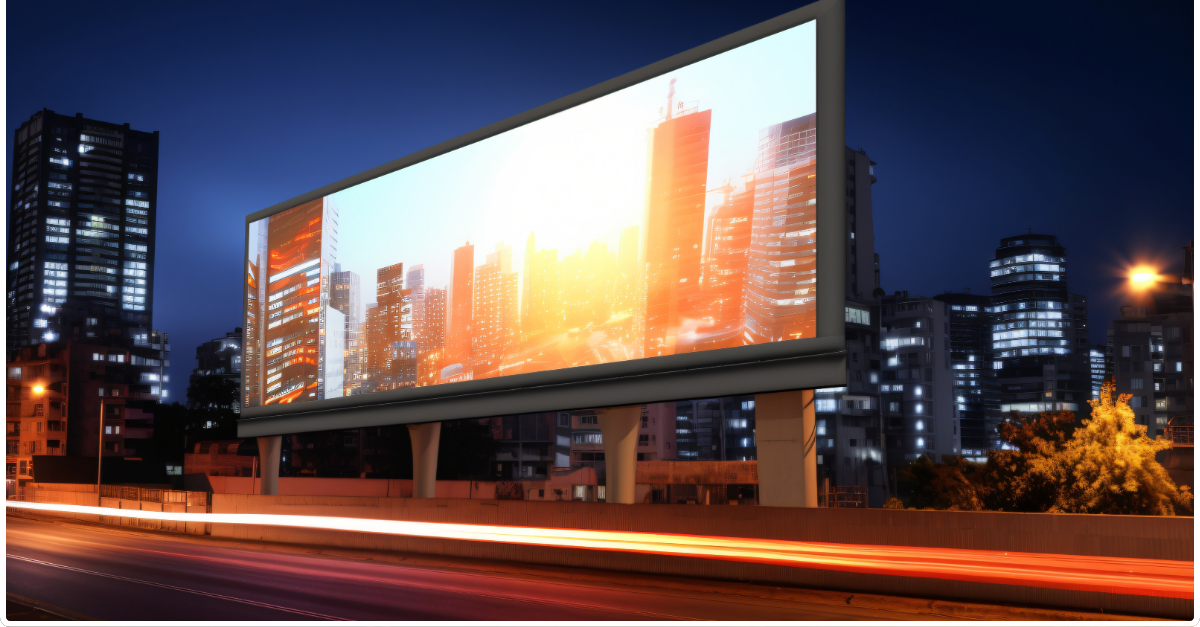
3D anamorphic billboards have become a global sensation, creating jaw-dropping illusions that stop people in their tracks. But behind the visual magic lies an extremely complex technical process. Executing a high-quality, large-scale 3D anamorphic billboard—especially in Indian outdoor environments—comes with several challenges.
1. Precise Viewing-Angle Calibration
3D illusions work only from a specific “sweet spot.”
Challenges:
-
Calculating the exact perspective geometry for the chosen viewing angle.
-
Aligning all visual elements so that distortion disappears when viewed from the target point.
-
Ensuring the illusion remains convincing even when real-world obstacles (traffic, street furniture) obstruct the line of sight.

2. Complex Content Rendering & File Size Management
3D anamorphic content requires ultra-high-resolution visuals.
Challenges:
-
Heavy 3D render files (often 8K–12K) demand powerful hardware.
-
Realistic shadows, reflections, lighting, and physics simulations significantly increase processing time.
-
Content must be optimized to avoid lag or pixel distortion on large DOOH LED screens.
3. LED Screen Quality & Pixel Pitch Constraints
Billboards need advanced display panels to make the 3D illusion believable.
Challenges:
-
Low-quality screens break the illusion due to light leakage or uneven brightness.
-
Larger pixel pitch (≥10mm) reduces detail; 3–6mm pitch is ideal but highly expensive.
-
Outdoor glare and sunlight can wash out depth cues needed for 3D realism.
4. Multi-Screen and Corner-Screen Synchronization
Most 3D anamorphic billboards use L-shaped corner screens.
Challenges:
-
Perfectly synchronizing content across both screens without frame delay.
-
Ensuring the joint between two screens does not distort the perspective.
-
Matching brightness, contrast, and refresh rates across screens.
5. Environmental and Structural Limitations
Indian outdoor environments add extra complexity.
Challenges:
-
Dust, heat, humidity, and monsoons can damage LED systems.
-
Mounting and alignment must be extremely stable to maintain perspective accuracy.
-
Power fluctuations can interrupt playback or damage hardware.
6. Camera Tracking & Motion Simulation for Dynamic Content
For motion-based illusions, the animation must respond to perspective shifts.
Challenges:
-
Calculating motion paths that maintain illusion integrity from the fixed viewing angle.
-
Using advanced camera-tracking and motion-capture tools for smooth transitions.
-
Ensuring moving objects don’t “break” the illusion due to misalignment.
7. High Production & Operational Costs
3D anamorphic projects are resource-intensive.
Challenges:
-
Requires specialized 3D artists, VFX experts, and technical engineers.
-
LED corner screens and high-powered servers significantly raise costs.
-
Continuous maintenance is needed to preserve image quality.

8. Regulatory and Compliance Barriers
Some city authorities restrict ultra-bright or complex motion billboards.
Challenges:
-
Approvals for brightness levels, animation speed, and screen placement.
-
Restrictions to avoid driver distraction on highways and crowded junctions.
-
Mandatory permissions for large-format DOOH installations.
Conclusion
Executing a large-scale 3D anamorphic billboard is not just about great design—it’s a blend of advanced engineering, visual science, premium hardware, and precise spatial planning. Brands that succeed in overcoming these challenges create viral, high-impact experiences that elevate visibility and engagement far beyond traditional outdoor advertising.