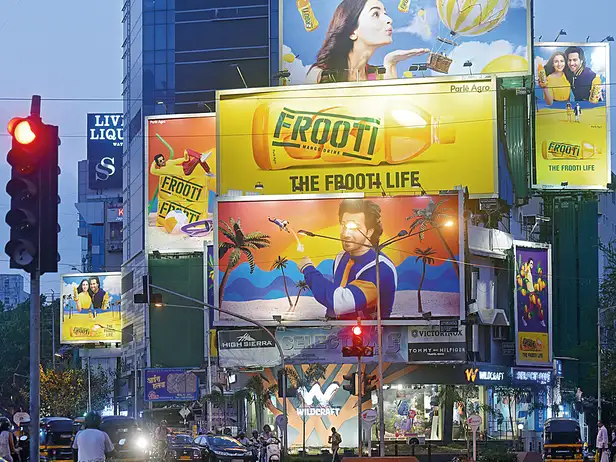
Booking a billboard in India isn’t as simple as picking a pretty spot and sending over a file. If you’ve ever navigated the chaotic streets of Mumbai, Delhi, or Bangalore, you know that India is a “high-context” market. What works on a highway in Dubai or a street in London will likely get swallowed whole by the visual noise of an Indian metro.
Before you sign that contract and wire the money, here is the “on-the-ground” reality of what you actually need to consider to make sure your billboard doesn’t just become part of the background scenery.
1. The “Viewability” vs. “Traffic Jam” Factor
In most countries, you want a billboard where cars go fast so you get “clean” views. In India, you want the traffic jam. * The Strategy: The “dwell time” in Indian traffic is legendary. A billboard advertising at a major bottleneck (like the Silk Board junction in Bangalore or the Western Express Highway in Mumbai) is worth three billboards on a free-flowing bypass.
-
The Check: Don’t just look at “impressions” on a spreadsheet. Ask the vendor: Is this at a signal where cars stop for 90 seconds? If the answer is yes, you can afford to put a little more detail in your creative.

2. The Language and “Local Flavor”
India is a continent disguised as a country. If you’re booking a campaign in Chennai, using a Hindi headline is a massive strategic blunder.
-
The Nuance: Even in “English-speaking” corporate hubs, a touch of the local vernacular (Hinglish in Delhi, Kannada in Bangalore, etc.) creates an instant emotional connection.
-
The Rule: Before you print, run your copy by a local. A phrase that sounds “cool” in a Mumbai boardroom might be culturally tone-deaf or just plain confusing in a Tier-2 city like Indore or Patna.
3. Lighting and “Load Shedding” (Electricity)
It sounds basic, but it’s the most common “fail” in Indian OOH. You might pay for a “backlit” or “front-lit” board, but if that specific neighborhood faces frequent power cuts or if the vendor is cutting corners on electricity, your ad is invisible after 6:30 PM.
-
The Fix: Ask for a “No-Illumination” clause in your contract. If the lights aren’t on during peak evening hours, you shouldn’t pay full price. Better yet, in 2026, many premium sites are moving to solar-powered LED—ask for those first.
4. Legal Permissions and “The Sticker”
The Indian OOH market is a mix of organized media owners and “fly-by-night” operators. Every legal billboard in a city like Delhi or Mumbai must have a registration number or a “permit sticker” from the local municipal corporation (like the BMC or MCD).
-
The Risk: If you book an illegal hoarding because it’s 40% cheaper, the authorities can tear it down or black it out overnight. You won’t get your money back, and your brand will look “shady.”
-
The Tip: Always ask for the Municipal Permission Letter for the specific site before booking.

5. Monsoon-Proofing Your Investment
If you are booking between June and September, you have to plan for the Indian Monsoon. Heavy winds and relentless rain can shred a cheap vinyl banner in 48 hours.
-
The Requirement: Ensure your contract includes “one free replacement” of the vinyl if it gets damaged by weather. Also, insist on high-grade Black-back Vinyl which is thicker and doesn’t become “see-through” when it gets wet or when the sun shines from behind it.
6. The “Obstruction” Audit
India’s urban landscape changes fast. A site that looked great in a photo from six months ago might now have a new Metro pillar in front of it, a growing Peepal tree covering the headline, or a new foot-over-bridge blocking the view.
-
The Reality Check: Never book a site based on “archive photos.” Demand a “Live Recce” (a video or photo taken within the last 48 hours) or, better yet, send a team member to stand at the site and see the “viewing angle” from a driver’s perspective.
The Final “Street-Smart” Checklist:
-
Is it “Clutter-Free”? If there are 10 other boards right next to it, your ad will get lost.
-
Is the “FOB” (Foot-over-bridge) blocking it? Common in Delhi and Bangalore.
-
Is the height right? In India, “Lower” is often better because people are looking at the road/traffic, not the sky.
Conclusion
Booking a billboard in India is a high-reward game, but it requires a “boots on the ground” approach. Don’t fall for the glossy sales deck. Focus on the traffic patterns, the local language, and the legal paperwork. When you get an Indian billboard right, you aren’t just reaching customers you’re becoming part of the city’s pulse.