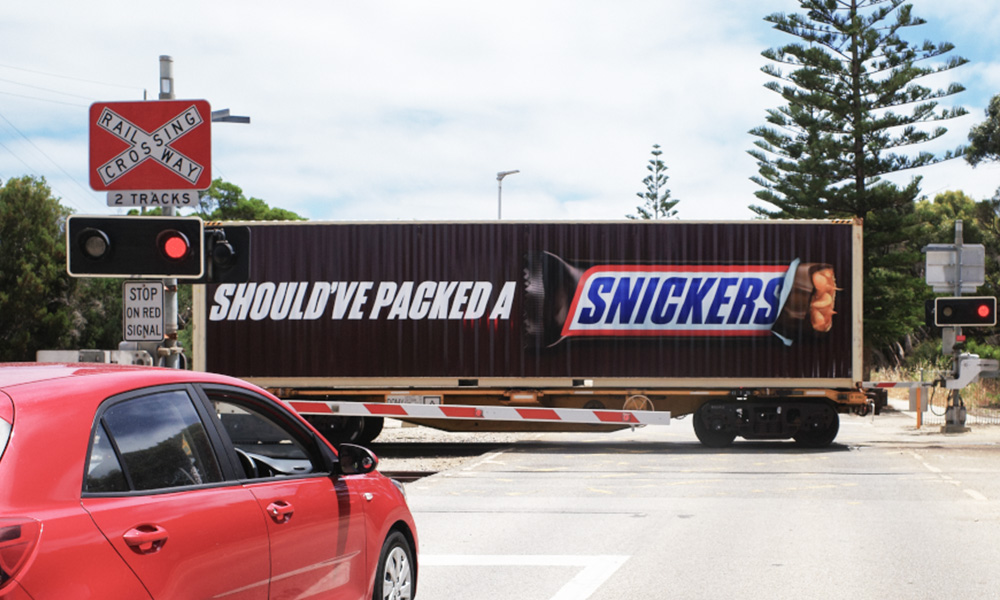
Snickers has once again proven that great advertising begins with insight. With its moving billboard on rails, the brand transforms one of the most universally disliked travel moments—waiting at railway crossings—into a clever and memorable brand interaction.
Developed by T&P Australia, the campaign avoids traditional roadside clutter. Instead, it places Snickers directly in front of hungry, impatient drivers at the precise moment their frustration peaks. As a result, the brand does not compete for attention; it earns it.
Why Is the Snickers Moving Billboard on Rails a Breakthrough in OOH Advertising?
Outdoor advertising often relies on fixed formats. However, this campaign flips the idea entirely. Snickers converts a 50-carriage freight train into a moving media asset, ensuring prolonged exposure rather than a fleeting glance.
Moreover, the format aligns perfectly with the situation. Drivers are already stopped, waiting, and watching the train pass. Therefore, the medium becomes inseparable from the message, creating an unmissable brand moment.
How Does Context Power the Snickers OOH Campaign?
Context sits at the heart of this execution. In regions such as Western Australia, commuters can spend hours each day stuck at level crossings. Snickers recognises this forced pause and uses it creatively instead of ignoring it.

Rather than distracting commuters from their irritation, the campaign acknowledges it. Consequently, the brand builds empathy and humour simultaneously. This approach strengthens emotional connection while reinforcing relevance.
What Role Does Copy Play in the Moving Billboard on Rails?
The campaign features four massive shipping containers, each wrapped in Snickers branding and sharp, dry copy. Lines such as “Impatient,” “Hangry,” “Long train, ay?” and “Should’ve packed a Snickers” speak directly to the moment.
Importantly, the copy remains short and instantly readable. Since drivers view the message over an extended period, repetition reinforces recall. As a result, Snickers embeds itself into the experience without feeling intrusive.
How Does This Campaign Reinforce “You’re Not You When You’re Hungry”?
Snickers has long owned the idea that hunger changes behaviour. This campaign extends that platform into real life. Stuck drivers, growing impatient by the minute, perfectly embody the brand truth.
By placing its message inside a real-world trigger for irritation, Snickers proves that its positioning is not just a slogan. Instead, it becomes a lived experience. Therefore, the campaign strengthens brand authenticity rather than merely repeating a tagline.
Why Is This an Example of Hyper-Contextual OOH Advertising?
The Snickers moving billboard on rails demonstrates how the environment itself can become the creative idea. The train is not just a carrier of advertising—it is the advertisement.
Because the campaign uses an unavoidable situation, it guarantees attention without aggressive tactics. This approach shows how hyper-contextual OOH can outperform traditional placements by aligning insight, timing, and medium.
Key Takeaway: What Can Brands Learn from the Snickers Moving Billboard on Rails?
This campaign proves that innovation does not always require new technology. Sometimes, it requires seeing everyday frustration as an opportunity.
By embracing reality instead of escaping it, the Snickers moving billboard on rails turns waiting time into brand time. Ultimately, it highlights how smart context, simple humour, and precise placement can elevate outdoor advertising into a memorable brand experience.