Complete Airport Advertising Funnel From Entry Gate to Boarding Gate
If you think airport advertising is just about “getting a big board,” you’re looking at it through a 2010 lens. In 2026, India’s airports from the revamped Terminal 1 in Delhi to the tech-first halls of Navi Mumbai have become sophisticated psychological mazes.
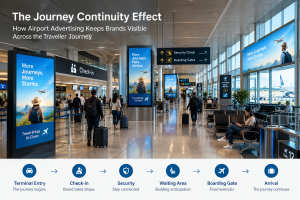
To market effectively here, you have to understand the “Traveler’s Mindset.” A person dropping off their bags is stressed; a person sitting in a lounge is bored; a person walking to the gate is expectant. Here is how a successful brand navigates the complete funnel in 2026.
Phase 1: The Perimeter (The “Aura” Moment)
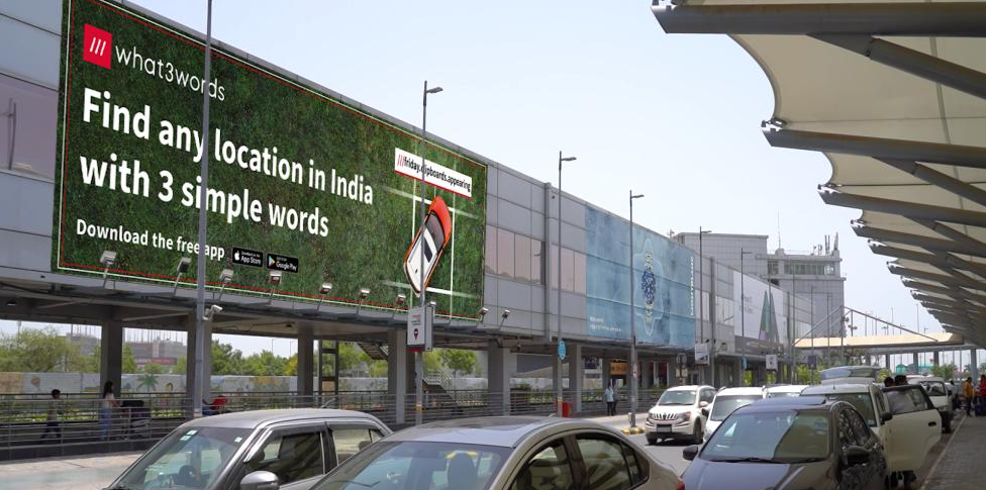
The funnel begins before the passenger even unbuckles their seatbelt in the taxi. As they pull up to the departure ramp advertising, they are greeted by massive exterior unipoles and facade wraps.
In 2026, this is where “Brand Stature” is built. You aren’t selling a product here; you are announcing your existence. Large-scale luxury and tech brands dominate this space because it’s the only time they have the traveler’s attention in an open, outdoor environment. It’s the “hero shot” of the funnel.
Phase 2: The Entry & Check-In (Functional Frequency)
The moment the traveler crosses the threshold, their brain switches to “survival mode.” They are looking for gates, flight status screens, and check-in counters.
Because they are moving quickly, high-frequency media is the winner here. This is why luggage trolley branding and FIDS (Flight Information Display Systems) are so effective. In 2026, many brands have moved to “Utility Branding”—sponsoring the very tools that help the passenger. Seeing a brand name on a trolley ten times during the walk to security creates a subconscious “friendliness” with the brand before the passenger even relaxes.
Phase 3: Post-Security (The “Golden Window” of Dwell Time)
This is the most critical part of the funnel. Once security is cleared, the traveler’s cortisol levels drop. They have passed the “hard part” and now have 60 to 90 minutes of “captive leisure.“
In 2026, this zone has been taken over by Digital Out-of-Home (DOOH) and 3D Anamorphic screens. You’ll see “naked-eye 3D” car launches or perfume bottles that seem to float in the air. This is the Consideration Phase. The traveler is finally relaxed enough to scan a QR code, watch a 15-second loop, or even walk into an experiential “Pop-up” zone. If you want a consumer to actually engage with your story, this is where you spend your budget.
Phase 4: The Lounge & Retail Corridors (Deep Engagement)
For the top 10% of flyers, the funnel moves into the VIP and Business Lounges. Here, the advertising is subtle, premium, and often interactive.
In 2026, we see a rise in “Integrated Utility.” A fintech brand might sponsor a high-speed charging pod where the screen shows market updates, or a premium mattress brand might create a “Napping Zone.” At this stage of the funnel, the goal is Association. You want the traveler to associate your brand with comfort, status, and exclusivity.

Phase 5: The Aero-bridge & Boarding (The Final Recall)
The final 50 meters before the plane is the narrowest part of the funnel the Aero-bridge. In 2026, these tunnels have been transformed into “Brand Corridors.“
As the passenger walks through the bridge, they are literally “wrapped” in your brand’s message. There are no other distractions no shops, no bathrooms, no flight screens. It is the most focused exposure in the entire journey. This serves as the “Final Word,” ensuring that your brand is the last thing they think about before they switch their phones to airplane mode.
Conclusion
Marketing at the airport branding is no longer a “one-off” billboard. It’s a relay race. A brand that greets you at the entry, helps you at check-in, entertains you in the lounge, and walks you to the plane is a brand that stays in your head long after you’ve landed.