QR Codes on Billboards: Linking OOH to Digital Sales
We’ve all been there stuck in traffic or waiting for a bus, seeing a brilliant ad for a product we actually want, and then… forgetting the name of the brand by the time we get home. That “memory gap” is where billions of dollars in potential sales go to die.
In 2026, the QR code is the “Delete” button for that gap. It turns a passive observation into an active digital lead in under three seconds.
1. Solving the “Attribution Headache”
The biggest struggle with traditional billboards has always been tracking. How do you prove that the person who bought your shoes saw the board on the I-95?
When a customer scans a QR code on a billboard, they enter a tracked ecosystem. You can see exactly which board they scanned, at what time, and on which day. This transforms OOH from a “brand awareness” play into a performance marketing channel. You can finally tell your CFO exactly how many dollars that vinyl sheet actually generated.
2. The “Contextual Discount”
Nobody scans a billboard just to see your homepage. People scan because they want a “win.” The most successful 2026 campaigns use incentivized scans.
-
The Hook: “Scan for 20% off your first order.”
-
The Result: The moment they scan, they have a digital coupon in their mobile wallet. Even if they don’t buy right that second, your brand is now “living” in their phone, ready for a reminder later that evening.

3. Frictionless “Wait-Time” Commerce
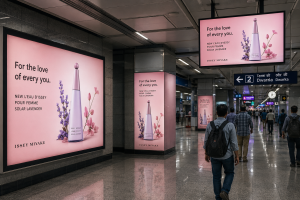
Transit advertising—think bus shelters, metro platforms, and train interiors is the natural home for the QR code. When someone is waiting three minutes for a train, they are looking for a distraction. We’re seeing a massive rise in “Instant Shopping” boards. A grocery brand displays a “pantry restock” list on a metro platform; the commuter scans the codes for milk, eggs, and bread, and the delivery is timed to arrive shortly after they get home. It’s not just an ad; it’s a service.
4. High-Res Optics: The 100-Foot Scan
One of the biggest tech shifts in 2026 is the sheer power of mobile cameras. You no longer need to be standing three feet away from a code. Modern smartphones can lock onto a high-contrast QR code from across a parking lot or from a car window at a red light. This “Long-Distance Scan” has opened up massive Unipoles and Gantries to interactive marketing that was previously impossible.
5. Retargeting the “Real World”
This is the “secret sauce.” When someone scans your billboard QR code, you can drop a pixel in their browser. Now, when that person goes on Instagram or Google later that day, you can show them a “retargeting” ad.
-
“Hey! Saw you looking at our new SUV on the highway today. Want to book a test drive?” This creates a seamless “Omnichannel” experience that makes your brand feel omnipresent.
Best Practices for 2026: Don’t Make These Mistakes
If you’re going to put a code on a board, do it right:
-
Size Matters: If it’s a highway board, the code needs to be massive. If it’s a pedestrian board, it can be subtle.
-
The Landing Page MUST be Mobile-Optimized: There is nothing more frustrating than scanning a code on a phone only to be sent to a desktop website that doesn’t load.
-
Call to Action (CTA): Never just put a naked QR code. Tell them why to scan. “Scan to Play,” “Scan to Save,” or “Scan to See in 3D.”
Conclusion
The billboard is no longer the end of the conversation it’s the start of the “Add to Cart” journey. By linking the physical scale of OOH with the tracking power of digital, QR codes have made outdoor advertising more accountable and more profitable than ever before.