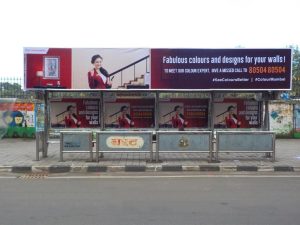
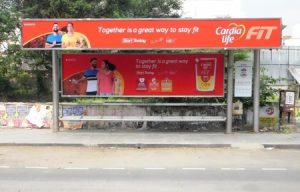
Why Bus Shelter Advertising Works Better Than Hoardings for Daily-Repetition Campaigns

Why bus shelter advertising works better than hoardings for daily-repetition campaigns through consistent exposure.
In high-frequency urban advertising, repetition plays a decisive role in shaping consumer memory. While hoardings traditionally dominate outdoor media plans, brands increasingly recognise why bus shelter advertising works better than hoardings for daily-repetition campaigns. The reason lies not in size, but in consistency, proximity, and behavioural exposure.
Bus shelters integrate seamlessly into everyday commuting routines. As a result, they deliver structured daily impressions that hoardings often fail to achieve despite their scale.
Understanding Daily-Repetition Campaigns
Daily-repetition campaigns focus on repeated exposure rather than one-time impact. The objective is not to surprise audiences, but to embed brand recall gradually through routine visibility.
Corporate IT tech parks offer powerful branding opportunities for companies to engage professionals through digital screens, standees, kiosks, and outdoor display campaigns. Car advertising in India offers brands a cost-effective and dynamic way to reach thousands of daily commuters through eye-catching vehicle wraps and mobile branding campaigns.
Such campaigns are especially effective for:
-
Financial services
-
Real estate
-
Education institutions
-
Healthcare brands
-
Consumer services
These categories rely on trust and familiarity rather than impulse response.
Limitations of Hoardings in Repetition-Driven Advertising
Hoardings offer scale, but they face several repetition challenges:
-
Located on fast-moving traffic corridors
-
Viewed briefly for a few seconds
-
Inconsistent exposure to the same audience
-
High cost limiting long campaign durations
Therefore, hoardings often generate reach without frequency.
For repetition-based objectives, this creates a strategic gap.
Why Bus Shelter Advertising Performs Better for Daily Repetition
Fixed Exposure Along Daily Commute Routes
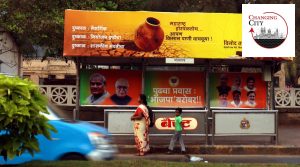
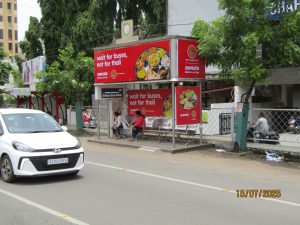
Bus shelters are placed along routine commuting paths. Office-goers, students, and local residents encounter the same shelter daily.
This repeated exposure strengthens brand familiarity organically.
Longer Viewing Duration
Commuters wait at bus shelters for several minutes. During this time, advertising remains directly within eye level.
In contrast, hoardings are often glanced at for only a moment.
Predictable Audience Repetition
The same group of commuters passes specific shelters daily. As a result, advertisers reach consistent audiences repeatedly rather than random viewers.
This predictability enhances recall efficiency.
Eye-Level Visibility Enhances Memory
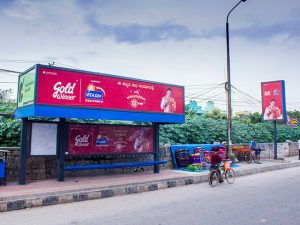
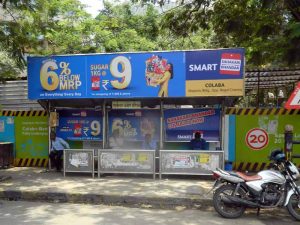
Bus shelter ads are positioned at eye height. This improves readability and logo recognition.
Hoardings, placed high above roads, often lose visual clarity.
Psychological Advantage of Bus Shelter Advertising
Familiarity Builds Trust
Repeated daily exposure builds psychological comfort. Over time, consumers subconsciously associate the brand with reliability and stability.
This trust formation is essential for long-cycle decision categories.
Non-Intrusive Presence
Bus shelter advertising does not interrupt content or movement. Instead, it exists passively within the environment.
This non-intrusive nature increases receptivity.
Cost Efficiency for Long-Duration Campaigns
Daily-repetition campaigns require sustained presence over weeks or months.
Bus shelter advertising allows:
-
Longer durations at manageable budgets
-
Wider geographic spread
-
Consistent creative display
Hoardings, due to high cost, often restrict campaign length.

As a result, repetition suffers.
Better Neighbourhood Penetration
Bus shelters operate within residential and mixed-use areas. This allows brands to penetrate neighbourhoods where purchase decisions actually occur.
Hoardings often remain concentrated on highways and arterial roads with lower local relevance.
Comparative View: Bus Shelters vs Hoardings
| Parameter | Bus Shelter Advertising | Hoardings |
|---|---|---|
| Exposure Frequency | High | Low |
| Viewing Duration | Long | Very short |
| Audience Consistency | Predictable | Random |
| Cost Efficiency | Strong | High cost |
| Trust Building | High | Moderate |
| Best Use | Repetition campaigns | Impact campaigns |
This comparison clearly explains why bus shelters outperform hoardings for repetition-led objectives.
Industries That Benefit Most
Bus shelter advertising is highly effective for:
-
Banks and NBFCs
-
Real estate developers
-
Coaching institutes
-
Hospitals and clinics
-
Local retail chains
These brands depend on memory reinforcement rather than instant action.
Integrating Bus Shelters with Hoardings Strategically
While bus shelters excel in repetition, hoardings still have a role in awareness creation.
An ideal strategy includes:
-
Hoardings for launch or announcement
-
Bus shelters for sustained reinforcement
This combination balances reach and frequency effectively.
Conclusion
Understanding why bus shelter advertising works better than hoardings for daily-repetition campaigns reveals a simple truth: memory is built through consistency, not scale.
By delivering eye-level visibility, predictable exposure, and long-duration presence within daily routines, bus shelters outperform hoardings in repetition-driven brand strategies.
For brands focused on trust, familiarity, and long-term recall, bus shelter advertising remains one of the most efficient outdoor media investments.